
It’s been thirty years now since John Piper—the longtime pastor of Bethlehem Baptist Church in Minneapolis—presented this illustration about how women should interact with men:
For example, a housewife in her backyard may be asked by a man how to get to the freeway. At that point she is giving a kind of leadership. She has superior knowledge that the man needs and he submits himself to her guidance. But we all know that there is a way for that housewife to direct the man that neither of them feels their mature femininity or masculinity compromised.
Recovering Biblical Manhood and Womanhood, 41
Okay, leaving aside the real question of why a random dude is creeping around in your backyard—this illustration paints a picture that any conversation where a woman has anything to teach a man is fraught with potential peril.
Unless the woman engages in some sort of subtle verbal dance that indicates her submission while she says: Sure, take a right on Morada, and the next right is the frontage road—she might somehow compromise his manhood and her womanhood.
(It also occurs to me that this illustration wouldn’t work at all now in this age of GPS.)
But Piper’s bizarre take is downright genteel compared to something Rachel Jankovic (who makes Phyllis Schlafly seem like Lady Gaga) said at the G3 Conference a couple of years ago:
It’s not true that women don’t lead in scripture. They repeatedly lead men into hell and death.
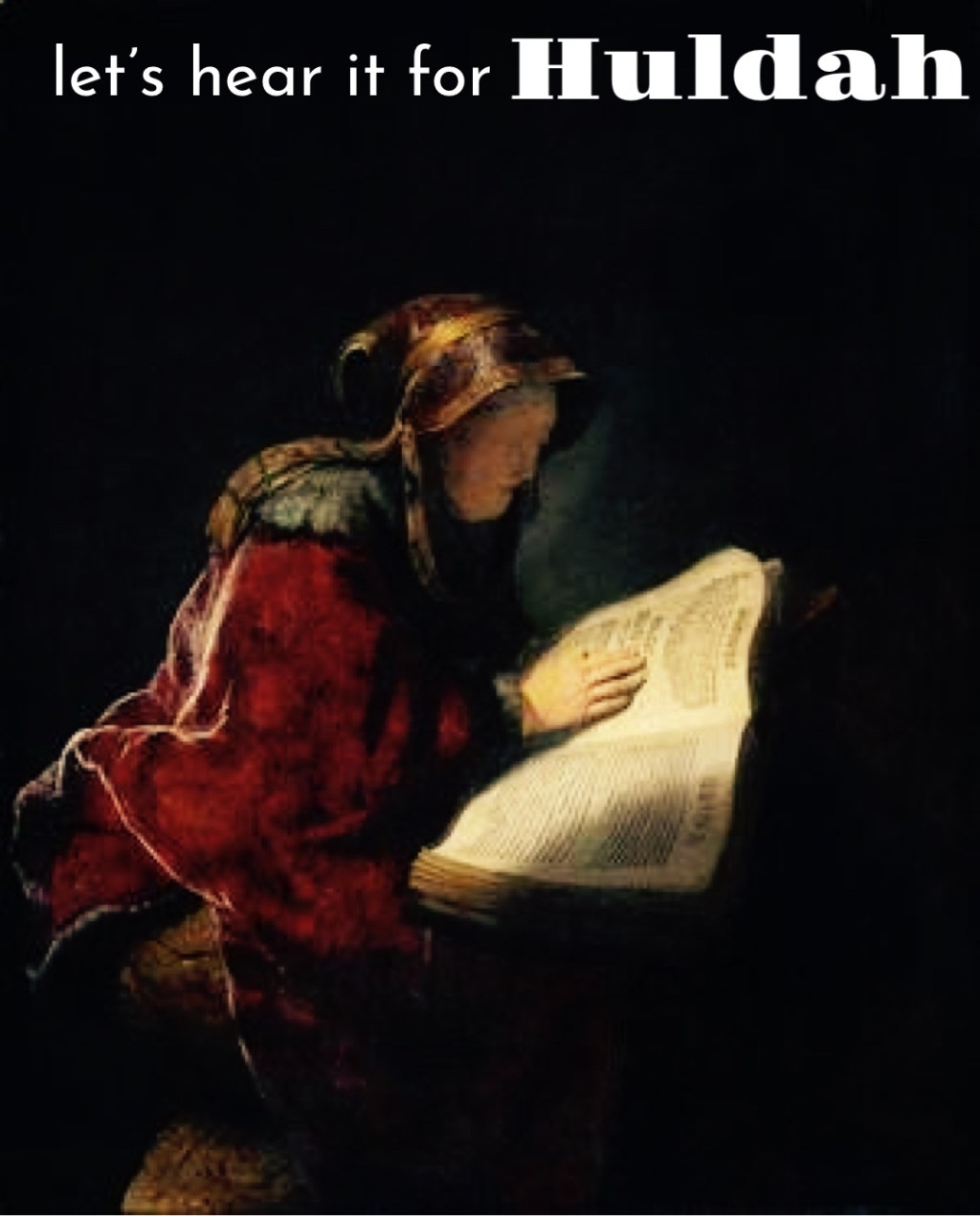
I have to wonder, in light of such statements, what Piper and Jankovic and their ilk believe that Huldah contributes to their concepts of “biblical” manhood and womanhood?
Maybe you’ve never heard of Huldah. Her story is recorded in both 2 Kings 22 and 2 Chronicles 34.
Here’s the backstory: After generations of ungodly leadership in Judah, young King Josiah arose and began a program of sweeping social and moral reforms.
Part of his agenda involved restoring the temple of the LORD, which had fallen into disrepair.
While repairs were being made, the long-lost book of the law—probably a copy of Deuteronomy, with its curses warned for disobedience—was discovered.
That’s where we’ll pick up with the story.
Then the court secretary Shaphan told the king, “The priest Hilkiah gave me a book,” and Shaphan read from it in the presence of the king. When the king heard the words of the law, he tore his clothes. Then he commanded Hilkiah, Ahikam son of Shaphan, Abdon son of Micah, the court secretary Shaphan, and the king’s servant Asaiah, “Go and inquire of the Lord for me and for those remaining in Israel and Judah, concerning the words of the book that was found. For great is the Lord’s wrath that is poured out on us because our ancestors have not kept the word of the Lord in order to do everything written in this book.”
2 Chronicles 34:18-21 CSB
So they went and inquired of the LORD. That is, they asked God to show them who could interpret the book of the Law for King Josiah.
Here’s who they came back with:
So Hilkiah and those the king had designated went to the prophetess Huldah, the wife of Shallum son of Tokhath, son of Hasrah, keeper of the wardrobe. She lived in Jerusalem in the Second District. They spoke with her about this.
2 Chronicles 34:22 CSB
This passage specifically says Huldah was a prophetess. That means she was authorized by God, not only to interpret scripture, but to speak on His behalf.
Many come to stories like this and say: Well, when the women have to teach the men, that’s a sign of God’s displeasure. There were no worthy men to explain the scriptures, so God had to raise up a woman.
That dog won’t hunt here, though. Because the prophets Jeremiah (Jeremiah 1:3) and Zephaniah (Zephaniah 1:1) were also active during Josiah’s reign.
Those are men who helped write the Bible. God could surely have used one of them if He wanted.
But God chose Huldah!
Not only that, but don’t let it be lost on you that while Huldah was a prophetess, her husband Shallum was keeper of the royal wardrobe!
So while Huldah was holding a Bible study for King Josiah, her husband was hemming the King’s robes.
I’m not sure what Piper or Jankovic would have to say about this state of affairs.
But King Josiah was a biblical man, and one of Judah and Israel’s rare faithful kings. Meanwhile, Huldah was a biblical woman—who was a prophet who taught Josiah the scriptures.
Two things are rather obvious here: First, contra Piper, neither Josiah’s masculinity nor Huldah’s femininity were threatened in any way by all this; and second, contra Jankovic, Huldah did not lead Josiah into death and hell.
Her teaching led to the greatest spiritual revival the nation ever knew:
So Josiah removed everything that was detestable from all the lands belonging to the Israelites, and he required all who were present in Israel to serve the Lord their God. Throughout his reign they did not turn aside from following the Lord, the God of their ancestors.
2 Chronicles 34:33 CSB
That kind of sounds like the opposite of death and hell to me.
I’m sure Huldah and Josiah didn’t see themselves as doing anything groundbreaking; and that Huldah didn’t imagine herself shattering glass ceilings.
They were just two people striving to be faithful in the work God had given them.
And I don’t believe that Huldah’s example will answer every question in the debates surrounding “gender roles” (I hate that term) in church, home, or society.
But any conversation regarding “biblical” manhood and womanhood is woefully incomplete without at least considering the important issues raised by Huldah’s story.
Men who like to sew might also find their biblical manhood affirmed in this story.
 the sermonator