
Here’s the backstory of this post: Fifteen years ago, I wrote a Master’s Thesis on the Sermon on the Mount.
The thesis came out to about 180 pages, give or take, and had the unwieldy title, Interpreting the Sermon on the Mount for Social Embodiment.
For reasons that are too boring to get into here, although the thesis was accepted, and I got my degree, I never had it bound and published along with the other theses in the university library.
And that’s just as well, I suppose. Because fifteen years later, I can say, without any reservations, that I no longer agree with the main motivation behind my thesis, which was simply this: That Jesus would not command us to do things we cannot do.
The gist of my reading of the Sermon on the Mount was this: We cannot do these things alone, but God has placed us in a community, and together we can obey what Christ taught us.
It was over a decade of wrestling with Matthew 5:48 that made me confess I was wrong.
That’s the verse where Christ tells us:
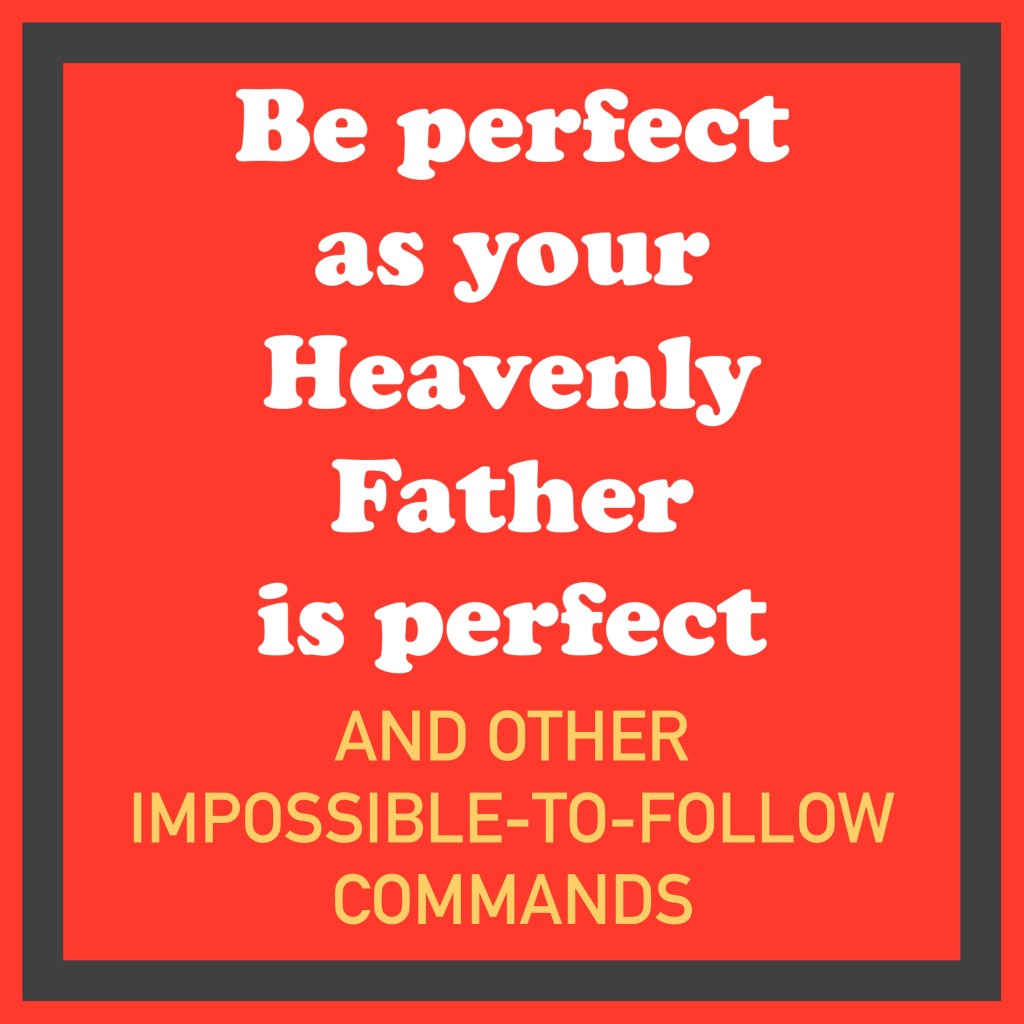
You therefore must be perfect, as your heavenly Father is perfect.
ESV
I had so many clever ways of getting around that verse.
Jesus didn’t mean be perfect to the same degree the Father is perfect! That would be impossible. He meant be perfect in the same way your Father is perfect.
So I took perfect to mean complete or whole (and it can mean that). And then I connected it to the bigger context: Christ is calling us to love our enemies, just like our Father does (Matthew 5:43-48).
And I would say it meant: Be inclusive with your love, loving even your enemies.
But I realized: Hey, actually I suck at that. Even on my best days, my love is partial, flawed, and has limits.
But not to fear, because I knew the Greek, and that the command here is plural: Y’all be perfect, as your Father is perfect.
And of course—that fit agenda of my thesis perfectly. Because no, the onus of loving so completely can’t fall on any one of us. Jesus knew better than that! That’s why He put us in a church with other believers who can be strong where we are weak, loving when we are just not feeling it. For every cranky Puddlegum in the kingdom of God, Christ has made sure there’s a half-dozen chipper, loving Lucy Pevensies to balance them out.
But I realized … No, that’s not true, either. Actually, often we’re worse as a group than as individuals when it comes to love. Not better! Many times it’s a brutal slog up a slick hill that’s just been rained on trying to get us just to love each other!
And I found that just preaching that we needed to love harder didn’t make it so.
I had to admit defeat: When Christ told us to be perfect as our Heavenly Father is perfect, He did indeed command something that’s impossible for us to do.
Then it occurred to me that, in fact, scripture is just brimming with commandments we can’t keep, and in fact—it tells us we can’t keep them.
Like when God says through the prophet Isaiah: Seek the Lord while he may be found (Isaiah 55:6 ESV). But elsewhere Paul says: no one seeks for God (Romans 3:11 ESV). As fallen sinners, it seems, we are constitutionally incapable of seeking God.
Or what about Deuteronomy 6:5, which Christ calls the first and greatest commandment: You shall love the Lord your God with all your heart and with all your soul and with all your might (Deuteronomy 6:5 ESV)? But then God has already said that the intention of man’s heart is evil from his youth (Genesis 8:21 ESV). And of course, the prophet Jeremiah said that: The heart is deceitful above all things, and desperately sick; who can understand it? (Jeremiah 17:9 ESV) Again, we seem to be constitutionally incapable of loving God with all our heart. But still, we see it bold as brass: God has commanded us to do just that.
Why would God command us to do what is patently impossible for fallen sinners, with our hearts bent towards wickedness, to do?
The answer is quite simple, really. St. Paul tells us that the law is holy, and the commandment is holy and righteous and good (Romans 7:12 ESV). God can do nothing other than command what is holy, righteous, and good; because He is holy, righteous, and good.
The problem lies with us: We are not holy, righteous, or good. Yet, God cannot negotiate His holiness, righteousness, or goodness just because we have failed to be those things: if we are faithless, he remains faithful— for he cannot deny himself. (2 Timothy 2:13 ESV)
But here is where we find the Gospel: we find Christ fulfilling the holy, righteous, and good commands of God, where we have failed.
We hear Jesus tell us to turn the other cheek when we are struck; to give the other garment and go naked ourselves from the courtroom; and to carry a burden that doesn’t rightfully belong to us. He tells us to give to every beggar (Matthew 5:38-42).
We have failed and continually fail at these things. But in His passion, we see Christ struck in the face, and not retaliate. We see Him stripped and His garments taken from Him. We see Him carrying a cross on His bloody shoulders that is rightfully ours.
And we find that He gives forgiveness and reconciliation freely to every poor-in-spirit beggar who throws themselves on His mercy.
We hear Christ tell us to be perfect in our love, even for our enemies (Matthew 5:44, 48). And then we are told: God shows his love for us in that while we were still sinners, Christ died for us … while we were enemies we were reconciled to God by the death of his Son (Romans 5:8, 10 ESV). The death of Christ for sinners was how God loved His enemies.
It dawned on me that Jesus was speaking of Himself, and what He would do on our behalf the entire time.
And then I realized: The impossible commands of the Sermon on the Mount, and scattered throughout the whole Bible, are meant to point us to Christ! To our great need for Him. So that we throw ourselves on His mercy.
You see, when I was under the impression that God wouldn’t command anything of us we couldn’t actually perform, I found myself constantly chipping away at the force of the commands from both sides.
First, I would water them down so that they seemed more attainable. Second, I would guilt trip myself and others into just trying harder to live up to these compromised commands.
But that’s not how any of this works.
No, the very impossibility of the commands is meant to crush us, and kill our pride and ego. Then we stand humbly before God, like the publican in Christ’s famous parable, and simply pray: God, be merciful to me, a sinner! And Christ tells us that anyone who prays that prayer goes away justified in God’s sight (Luke 18:13-14).
 the sermonator