
The notes for my message at Brooks Avenue Church of Christ in Raleigh, NC for August 18, 2022.
Introduction: God helps those who help themselves is not the Gospel
The church in the late Middle Ages had largely forgotten the Gospel.
Their doctrine of how to be saved was summed up in the Latin phrase: Facientibus quod in se est Deus non denegat gratiam. In English, that would be: Do what lies within you, and God will not deny you His grace.
It was basically the mediaeval version of, God helps those who help themselves. That’s it—that was how they summed up the Christian life. You do your best, and God will take care of the rest. Is that the Gospel?
Get this: Way back in the year 2000, Christian pollster George Barna found that the most widely-known Bible verse among adult and teen believers is “God helps those who help themselves.” Barna of course immediately noted that this verse is not actually in the Bible.
Has the church in America regressed back into the Dark Ages?
Growing up, we had a preacher who taught us about grace and works, and the role each one played in our salvation. He told us, basically, that you try your best to be obedient and not to sin; and then God will supply what you’re lacking. Essentially, you do about 75% of the work, and God does the other 25%.
You run the race until you’re too exhausted to stand up anymore, and grace is God dragging you those last few feet, across the finish line.
Rare is the preacher who would be so bold as to try and quantify it with numbers like that. But I do wonder sometimes if that’s how we really think about grace. It’s God helping those who help themselves. It’s grace because He could choose not to help at all.
Again, I ask: Is that the Gospel?
In the 6th century before Christ, Aesop told a fable about a drowning man who called on the goddess Athena to save him. She replied: Have you tried swimming yet?
In the 5th century B.C., the Greek poet Euripides wrote: Try first thyself, and after call in God; For to the worker God himself lends aid.
There’s an ancient Chinese proverb that says: Heaven helps the diligent.
And then the Islamic Qur’an says that: Allah will not change the conditions of a population until they change what is in themselves.
Do what is in you and God will not deny you His grace, is not the Gospel. It’s not Good News to humans struggling under the weight of their sin and guilt over the things they’ve done and left undone.
The world is already full of philosophies that teach us that God helps those who help themselves. But does Christianity have any Good News?
Last week, we heard the Gospel from Ephesians 2:1-7. The 200-proof good news, straight, no chaser. The Gospel tells us that when we were dead in our sin, God made us alive with Christ. Last I checked, no one is more helpless than a dead person.
What makes Christianity superior to every other philosophy or worldview is the answer we are able to give to sinners, strugglers, and sufferers who desperately want to know if there’s any good news.
You’re supposed to be able to say: Yes! God helps those who cannot help themselves.
And if we ever get confused on that point, we need to just shut the doors, because we have nothing to offer the world. They can get, God helps those who help themselves at home.
Bridge: Rightly dividing our prepositions
But of course, someone will always come along and ask: Yes, but God commands us to do stuff; and not to do other stuff. Indeed He does. You will never hear me deny that.
A crucial aspect of what 2 Timothy 2:15 calls rightly dividing the word of truth is being able to make a distinction between the Gospel and the Law. That is, between what God does, and what we do. And especially, the immensity of what God does, and the limitations of what we do.
Left to our own devices, we are apt to muddle it up, and turn the Gospel into a kind of soggy casserole of grace and works. Some of my friends call this unappetizing dish Glawspel—Gospel with a bunch of Law baked into it. And yeah, it’s about as gross as it sounds. But you’d be amazed at how often it’s served at church potlucks. I mean, pulpits.
Our text today is Ephesians 2:8-10, so it comes right after what we looked at last week. And the beautiful thing about these verses is that they very clearly and elegantly spell out the proper relationship between Gospel and Law, grace and works.
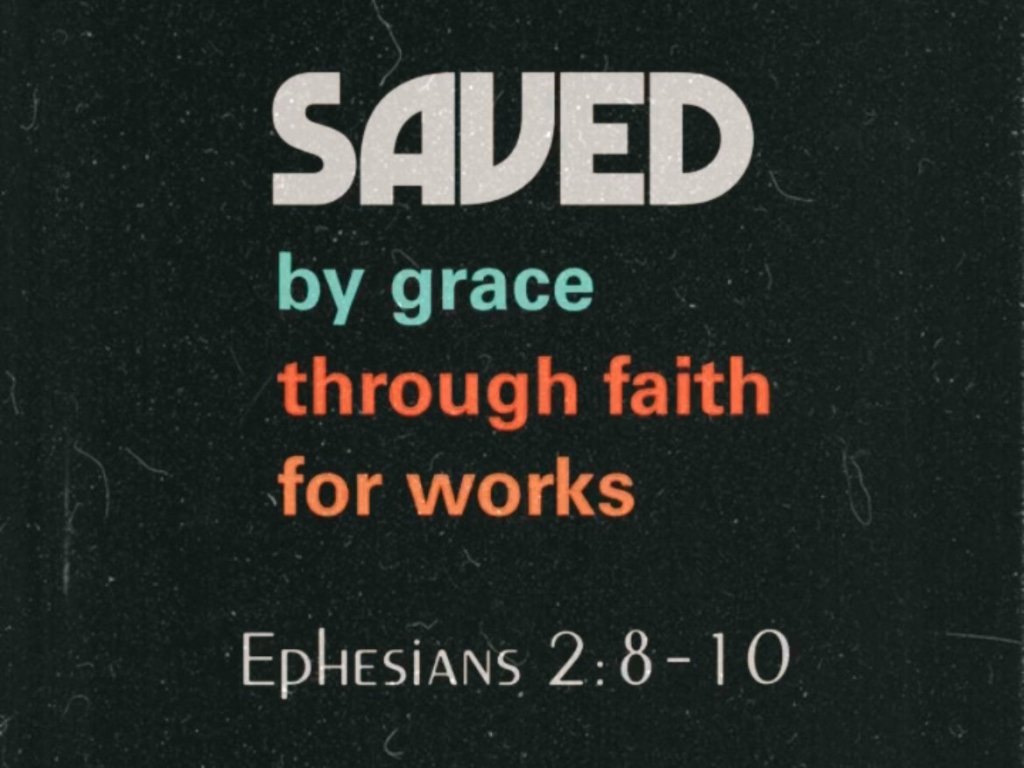
These verses tell us that we are saved by grace, through faith, for good works. See how simple that is? Say it with me: By grace. Through faith. For good works.
As long as you keep your prepositions straight, you can never go wrong.
Preposition 1: Saved by grace
First, we are saved by grace. Ephesians 2:8 is a very famous passage. For you are saved by grace through faith, and this is not from yourselves; it is God’s gift. Sometimes I fear we’ve heard it so often that it doesn’t even impress us anymore. We’ve managed to take the amazing plumb out grace.
Many years ago I saw a commercial for a church in Kentucky, and at the end of the commercial, the preacher would say: The soul you save may be your own. I sighed and told the TV: “Brother, you have completely lost the script. We don’t save ourselves. We can’t.”
Salvation must be completely the work of God. Remember what we heard last week from the beginning of the Ephesians 2. We were dead in our sin, and God raised us up with Christ.
The early American preacher Jonathan Edwards used to say: You contribute nothing to your salvation but the sin that made it necessary.
The grace that saves us is not God helping us after we have helped ourselves. It’s not heaven rewarding the diligent. It’s not God dragging us the last few feet of the way after we have run most of the race. It’s not God rounding up our grade after we’ve tried our best.
We were dead, remember? Dead people don’t help themselves. The grace that saves you is God finishing the good work He began in you (Philippians 1:6). Christ is the author and the finisher of the whole bag (Hebrews 12:2).
Grace is Christ creating the tree that He would one day be nailed to, to atone for your sin. Grace is Christ placing the ore in the mountains that would one day be turned to metal spikes and driven through His hands and feet.
Grace is Christ crucified and risen for you. Can I repeat that? For you. Why don’t you tell it to yourself? Say: Christ for me.
2 Corinthians 5:21 says that God made the one who did not know sin to be sin for us, so that in him we might become the righteousness of God.
Grace is Christ living a perfect, sinless, obedient life for you. In your place. Remember how when He was dying on the cross, there were men gambling over His seamless robe? Well, you see—when you come to Christ, you are given His robe. God covers your shabby life in the seamless robe of Christ’s perfect life.
Grace is Christ suffering the doom your sins deserved. The wages of sin is death, Romans 6:23. You earned the awful wages of your sin, but the reckoning fell on Him.
He took your sin and misery on Himself, and you received His righteousness. That’s grace. He died to give you life. That’s grace. You will ride to glory on His train. That’s grace.
You know that old poem about the man whose looking back at his life, and he sees the two sets of footprints in the sand? One set was his, and the other was Christ’s. And during his times of trouble and hardship, the two sets of footprints dwindle down to one. So he says to Jesus: Why did you leave me to walk alone through my darkest trials? But Jesus says to Him: No, where you only see one set of footprints, thats where I carried you.
But the the grace that saves us doesn’t just walk alongside us and carry us along when we need some extra help. No—when Ephesians 2:8 says you were saved by grace, it means there only ever was one set of footprints. And look—they have the mark of the nails that crucified Him in them.
So that’s your first preposition: By grace you are saved. Saved by grace means it does not depend on human will or effort but on God who shows mercy (Romans 9:16).
Preposition 2: Saved through faith
The next preposition—We are saved through faith. Vv 8-9 of Ephesians 2:
For you are saved by grace through faith, and this is not from yourselves; it is God’s gift—not from works, so that no one can boast.
Christian Standard Bible
This preposition, through faith, is crucial. You are not saved by faith, but through faith. Let me explain the distinction.
The basis of salvation is God’s grace. You are saved by grace. But you receive salvation through faith.
Here’s what I’m getting at. Your faith does not earn salvation. Christ’s perfect life, atoning death, and resurrection on the third day is what has earned your salvation. Faith is the instrument by which you receive Christ’s life, death, and resurrection for you.
So in these verses, you see—faith is empty hands, into which God lavishly pours out grace upon grace upon grace in Christ. Like the old hymn we sing—Nothing in my hand I bring. Do you really mean that when you sing it?
You see, if faith were this thing you just had to muster up inside of you, and then you could have salvation—then faith would be a work. You would be saved by your own effort. But as it stands, even your faith is a gift. What does it say here? And this is not from yourselves; it is God’s gift.
Last week, we saw that salvation is a matter of dead people coming to life. Who empowers dead people to hear and believe the Gospel? In John 3, Jesus famously told Nicodemus: Except a man be born again, he cannot see the kingdom of God. Now, childbirth is not a cooperative effort. What a mean is, a baby cannot take credit for being born. Mamas, am I right?
And that’s exactly what St. Paul is trying to make sure we understand in these verses: so that no one can boast. Rather, we are told: Let the one who boasts, boast in the Lord (1 Corinthians 1:31).
The ancient Christian theologian Augustine gives us a fantastic example of what it sounds like when we boast in the Lord. He used to say: Lord, everything good in me is due to you. The rest is my fault. Whatever in us is pure, true, just, honorable, lovely, and commendable is from God—and that includes our faith.
So where does faith come from? God brings it to life in you, by His Spirit, in the preaching of the Gospel.
Listen very carefully. This is from Romans 10, vv14, 17. I don’t believe we have plumbed the implications of these words. When we do, awe and wonder should follow.
How then shall they call on him in whom they have not believed?—for whosoever shall call upon the name of the Lord shall be saved, Romans 10:13. And how shall they believe in him of whom they have not heard? and how shall they hear without a preacher? Now, v17: So then faith cometh by hearing, and hearing by the word of God.
Faith comes by hearing, and hearing by the word of God. Remember, God’s Word is living and active (Hebrews 4:12). God’s Word has power in itself to create life. By His Word, God gives life to the dead and calls into existence the things that do not exist (Romans 4:17).
Where the Gospel is unleashed, naked and unashamed—not timidly, not tepidly, not with you putting so many qualifiers on it and walking it back and hedging it in with so many, yeah buts that it stops being Good News—when the Gospel is unleashed, the Spirit opens dead ears to hear, regenerates stony hearts to repentance, and opens empty hands to receive Christ.
Nothing in my hands I bring—says the old hymn; simply to Thy cross I cling. That’s what these verses are getting at when they tell us our salvation is through faith, and not by works.
Faith and works are two different paths you can choose to obtain eternal life. But they are parallel paths—they don’t intertwine.
Paul made this point so abundantly clear to the churches of Galatia that it seems to me you can only get this wrong if you’re trying to. Galatians 3:10-12, listen very carefully, church:
For all who rely on the works of the law—that is, when you rely on how well you keep God’s commandments for your salvation, the people who try and do that—are under a curse, because it is written, Everyone who does not do everything written in the book of the law is cursed. Now it is clear that no one is justified before God by the law, because the righteous will live by faith. But the law is not based on faith; instead, the one who does these things will live by them.
Here’s the weight of that warning. You can try and earn your way by your own doing, but you will perish trying. Because the only way you can be declared righteous before God through your own efforts is perfect, precise, and perpetual obedience to every command, in every word, thought, and deed.
That’s why Paul said those who try and go that way are under a curse.There are currently hundreds of dead bodies littering Mt. Everest, of people who tried to conquer the mountain, and perished in the attempt. The mountain conquered them. Their corpses serve as a bitter warning about the mountain’s unforgiving nature.
But you see, people still climb that brutal mountain because even though many have died going up it, many have also reached the peak. By contrast, no fallen, mortal son of Adam or daughter of Eve has ever succeeded in conquering the mountain of God’s Law. That mountain is infinitely more unforgiving than Mt. Everest.
When God expelled Adam and Eve from the garden after their sin, He placed cherubim at its eastern gate, with flaming swords, to guard the way back. After our first parents rebelled against the Lord, no one can make their way back to Him by their own righteousness. You see, in their fall—they lost that option for all of us.
Now, the only way back is in Christ, by His righteousness for us. And the only way into Him is through faith. The Law, Paul said in Galatians 3, is not of faith. We do not build a tower into heaven built partly of Christ’s work, and partly of our own. Rather, He alone is the ladder from earth to heaven. And we climb to glory on His work—not our own.
In that sense, you have been saved by works, but it’s Christ’s perfect, finished work. Not yours.
You see—these prepositions of salvation: by grace, through faith, not by works: they’re really categories we must learn to think in. I am not saved on the basis of my own efforts—not even in part. They earn me nothing. Jesus even said: when you have done all that you were commanded, you should say, “We are unworthy servants; we’ve only done our duty.” (Luke 17:10). You put your efforts into that category.
Rather, we are saved by grace—that is, on the basis of what God has provided to us in Christ. You are saved by Christ’s life, death, and resurrection for you. So you put Christ’s work into that category. It’s outside of you.
And we are saved through faith. Faith is your empty hands receiving Christ, grasping God’s promises. But don’t ever forget Who opened your hands, and who gives you the strength to cling to the promises. What do you have that you didn’t receive? (1 Corinthians 4:7) Faith is the vessel in which we receive God’s grace. So put it in that category.
So I am confident to say that we are saved by faith alone. Yes, I know James 2 is in the Bible. I could—and have—preached an entire series of sermons on it.
But just as confidently, I affirm that the faith that saves is never alone. After all, doesn’t Scripture teach us that faith, hope, and love abide, these three (1 Corinthians 13:13)? Faith always brings hope and love with it.
With that in mind, let’s look at our final category. We are not saved by our good works; but we are saved for good works. That’s what we learn in v10.
Preposition 3: Saved for good works
So Ephesians 2:8-9 tells us the what of the Gospel: We are saved by grace, through faith—not by works, lest we should boast.
Romans 4:2 tells us that if Abraham was justified by works, he has something to boast about—but not before God. If your own works could merit you salvation; or even add to it, you would have something to brag about.
Here’s what I mean. On March 28, 1990, Michael Jordan scored an astounding sixty-nine points in a game against the Cleveland Cavaliers. That night, his teammate, a rookie named Stacey King, also scored one point. When being interviewed later, Stacey King said: I will always remember this as the night that Michael Jordan and I combined to score seventy points. God knows full well that if we could take credit for any part of our salvation, we will. Even if God said: I will do 99% of it, and you must only do 1%—we would find a way to Stacey King God.
But of course, Scripture still expects Christians, who are saved by grace and not by works, to do good works. But again—the prepositions here help us make crucial distinctions, so we get the Gospel wrong. Because if you get the Gospel wrong, the whole thing is wrong. We are saved by grace, through faith, for good works.
That’s what Ephesians 2:10 teaches us: For we are his workmanship, created in Christ Jesus for good works, which God prepared ahead of time for us to do.
Again, you are God’s handiwork, created in Christ Jesus. Psalm 100:3 proclaims: it is he that hath made us, and not we ourselves. God has made you alive in Christ. You can’t take any credit for it, no more than a baby gets credit for being born. You don’t help God create you anew in Christ. It is not, God will not deny you His grace as long as you are doing your best. It is, God—completely of His grace, has brought you to life in Christ; He has faithed you, and He has repented you, so that you can actually begin to do good.
Since the earliest days of the church, critics have objected to this whole setup. When Paul taught by grace, through faith, in Christ, people would interrupt and ask him: What shall we say then? Are we to continue in sin that grace may abound? (Romans 6:1)
See, we have this fear that if you tell people that they are saved apart from their works, they’ll get lazy and carnal and just slide back into sin.
Keeping our prepositions in good order helps us here. God saved us by grace—apart from any good works we have done or will do; through faith; for good works.
Don’t collapse the good works back into the grace or the faith. You are not saved by grace and works, or through faith and works; but by grace, through faith, for good works.
Now it’s right here that people ask: If I am not saved in whole or in part by my good works, then why do I need to do good works?
I’m glad you asked that. The Bible gives all sorts of reasons. Here’s three I can think of off the top of my head.
First, we do good works because we are grateful to God for saving us. This is what Romans 12:1 teaches: Therefore, brothers and sisters, in view of the mercies of God, I urge you to present your bodies as a living sacrifice, holy and pleasing to God; this is your true worship. We can never pay back our salvation, but we do tell God thank you for His mercies by offering our lives, our minds, our hearts, and our efforts to serving Him and loving our neighbors. So—not to be saved, but because we have been saved.
Second, our good works help assure us that our faith is real. Galatians 5:22-23 tells us what is the fruit of the Spirit: love, joy, peace, patience, kindness, goodness, faithfulness, gentleness, and self-control. It is the fruit of the Spirit, not the fruit of me. And notice those are all going to show themselves in how you relate to other people. So when you begin to see even the smallest blossoms of love and joy and peace and kindness, where they weren’t there before—you can say: Wow, the Holy Spirit really is working in me! And that helps your assurance.
Third—and this is really important—God works through our good works to draw our unbelieving neighbors to Him. What did Christ tell us? Matthew 5:16: Let your light shine before others, so that they may see your good works and give glory to your Father in heaven.
Listen, God doesn’t need your good works to know if your faith is any good or not: The Lord knows those who are his (2 Timothy 2:19). The great German Reformer Martin Luther said: God does not need your good works, but your neighbor does.
When you do good works with the idea that, Hey, I have this unnamed quota I have to meet to stay saved—then you are not doing good because you love your neighbor. You’re doing good trying to impress God. But God is unimpressible. He has saved you by grace through faith—regenerated you in Christ, He’s given you a new heart, and put His own Spirit in you—so that you will do good works.
And you don’t even have to go around searching for good to do. Listen—it says God already prepared good works beforehand specifically for you to do.
Listen, when you are up with that baby with an ear infection at three in the morning; when you are gently tending to the bruised reeds and smoking wicks of the church—the extra grace required people, the people who are always living through some crisis; when you’re baking a casserole for that widow who just lost her husband—God prepared that good work specifically for you to do. Listen, please listen. Don’t ever say: Oh, those aren’t special, anybody could do that! Don’t you blaspheme! God chose you to do it, so that He could love your neighbor through you.
God prepared good works for you to do from the foundation of the world. He saved you for good works—so He could give His good gifts to others through your shaky hands. God delights in drawing straight lines with crooked sticks.
Even your good works are a gift from God. Again, St. Paul asks: What do you have that you did not receive? (1 Corinthians 4:7). You can’t even take any credit for your good works, because God gave them to you.
This morning, if faith has come to life in you—today is the day of salvation. Come receive Christ for you in baptism. God will birth you again by water and the Spirit, and make you a new creation—saved for good works, according to His eternal purpose. This is the gift of God.
And shortly we will share in the Lord’s Supper. Remember that it is Christ’s body and blood, His perfect life and atoning death—for you. You didn’t earn a seat at His table by being so good and holy this week. What qualifies you to sit at His table is being a sinner in need of forgiveness.
So be strengthened and nurtured from His table to go out and do good. And remember—even the good works you do are God’s gift to you, for His glory and the good of your neighbor.
 the sermonator