

One of the more difficult things to do in theology is to give a systematic account of the final judgment.
It’s even harder when you’re a biblicist, because you’re not really going to care if you can give a systematic account of it. But there are consequences for your refusal to do so.
How many of you have seen a baby playing with one of those toys where certain blocks go into holes of a corresponding shape? Inevitably, the first few tries, you see the child trying to force an octagon into a circle or some such. Eventually, they get it right. But until then, you will see them frustrated as they try to force the block into a hole it’s not meant to fit. Sometimes they might place a round peg into a square hole. And maybe it goes in—sort of—but there’s all this empty space at the corners.
Here’s my point: A biblicist is someone who believes they can go into studying and applying the Scriptures without any pre-existing assumptions or commitments. They eschew any written creeds, and look sideways at systematic theology. I just believe what it says and let the chips fall where they may.
They believe this somehow makes them more faithful. What it really does, more often than not, is make them stay little babies in the Word, forever trying to jam circles into octagons, and pretending that the spaces at the corners are there because God meant them to be there.
As I said—one cannot do this without consequences. Systematic theology helps us know which block goes in what hole. Those who refuse to let their study of the Scriptures be formed under the Ecumenical Creeds, and submitted to the discipline of a healthy, robust systematic theology, inevitably introduce confusion and mystery where there doesn’t need to be any.
Having a healthy systematic theology helps give clarity where there might be confusion, and only leaves to mystery those things God has declared will remain a mystery: The secret things belong to the Lord our God, but those things which are revealed belong to us and to our children forever, so that we may keep all the words of this law. (Deuteronomy 29:29 MEV) A robust systematic theology says, for example: Here is Law, and that block goes there, here is Gospel, and this block goes here. So that we are not left in confusion and suspense.
Again, there are consequences for failing to do this. Final judgment falls under the already-fraught category of eschatology—that is, the doctrine of last things. With all the Left Behind hoopla and ever-evolving end times charts of the dispensationalists, many believers are already confused and uncertain about what the end of history holds. But if you cannot at least give them a clear-eyed view of final judgment, you’re only going to terrorize them with it. Who knows—maybe that’s the actual goal of many biblicists. It’s certainly a method of control.
But Scripture teaches believers to be waiting for and desiring the coming day of God (2 Peter 3:12 MEV). We ought to be able to say: Come Lord Jesus! (Revelation 22:20) We cannot do this if we’re uncertain about it, uncertain of God’s promises, and without assurance or security.
That’s a long introduction to say this: Our understanding of what to do with texts concerning the final judgment is directly related to the categories of Law and Gospel, faith and works. The example text I want to explore this thesis with is 2 Corinthians 5:10–11:
For we must all appear before the judgment seat of Christ, that each one may receive his recompense in the body, according to what he has done, whether it was good or bad. Therefore, knowing the fear of the Lord, we persuade men. But we are revealed to God, and I trust we are also revealed in your consciences.
MEV
Many read, understand, and preach this text to mean that the final judgment is a judgment of works. That is, at the last day, Christ will decide the eternal fate of each individual based upon the works they have done in this life. Faith in Christ will be necessary but not sufficient for attaining eternal life.
One example of this kind of thinking is an infamous throw down from popular preacher John Piper in the introduction to Tom Schreiner’s Faith Alone: The Doctrine of Justification (Grand Rapids: Zondervan, 2015):
The stunning Christian answer is: sola fide—faith alone. But be sure you hear this carefully and precisely: He says right with God by faith alone, not attain heaven by faith alone. There are other conditions for attaining heaven, but no others for entering a right relationship to God. In fact, one must already be in a right relationship with God by faith alone in order to meet the other conditions
p. 11
And far from clarifying this, Piper has only doubled down and continued to muddy the waters, as we can see from the following Tweet:
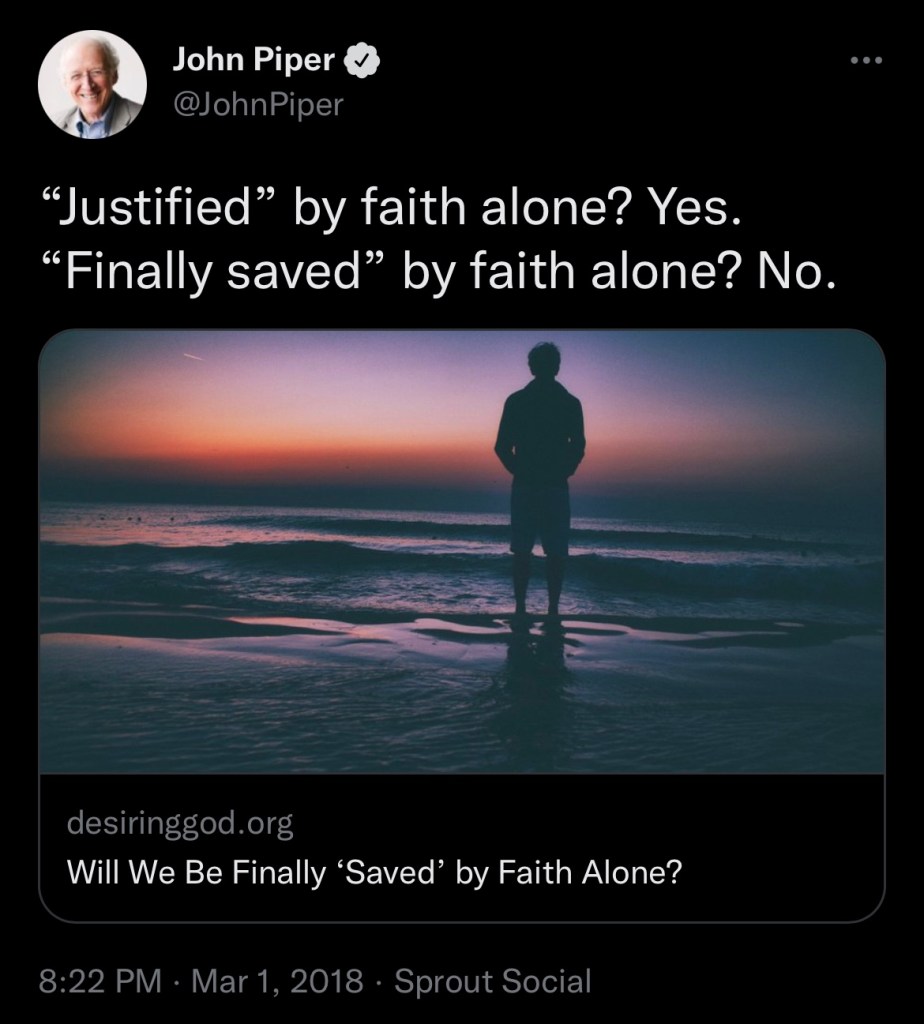
Piper wants to divorce justification from what he calls “final salvation,” in a way that makes our own works instrumental to our salvation. But justification, sanctification, and glorification—all aspects of salvation—are inseparably, organically joined. Thus the great “golden chain” of redemption:
For those whom He foreknew, He predestined to be conformed to the image of His Son, so that He might be the firstborn among many brothers. And those whom He predestined, He also called; and those whom He called, He also justified; and those whom He justified, He also glorified.
Romans 8:29-30 MEV
Notice who’s doing all the verbs: God.
This is not to deny that works are important, or that saving faith will necessarily produce good works. I believe those things wholeheartedly. Good works are a fruit of good faith. The issue—if you’ll allow me to entertain another metaphor—is to make sure you put that fruit in the right basket.
And now: On to putting what 2 Corinthians 5:10-11 says about a final judgment according to works in the right basket. Strap yourself in, this is going to be quite a ride, and I’m going to take the scenic route.
The truth will be revealed before the judgment seat of Christ
So, 2 Corinthians 5:10 begins: For we must all appear before the judgment seat of Christ.
So already, there are questions. Who is included in we all? Does we all include every single human? Or in this instance, does it mean all Christians? Or—and this is interesting—is Paul referring primarily to himself and his fellow evangelists? (See vv11ff)
Let’s assume it means every single human who has ever lived. Well, then there are believers and unbelievers together.
I’m going to get to the judgment part later. But first there’s something I need to point out. And it’s the word translated as appear. This verb is φανερόω (phanero’ō), and in English translation, it’s a bit tricky here. Because our inclination is to see this verb in English, in this context, and think of appearing before a judge, on trial, and having a verdict pronounced. That’s completely understandable.
But now it’s time to have your minds blown. I included verse 11 for a reason, and I’m going to show you it. Look at the last part of it, and let me show you the Greek verb. It’ll be familiar to you now.
But we are revealed [φανερόω] to God, and I trust we are also revealed [φανερόω] in your consciences.
That’s right. In v11, the verb φανερόω, translated as appear in v10; is translated as revealed in v11.
To help give you a sense of the verb, here’s somewhere else it appears twice:
Beloved, now are we children of God, and it has not yet been revealed [φανερόω] what we shall be. But we know that when He appears, [φανερόω] we shall be like Him, for we shall see Him as He is.
1 John 3:2 MEV
Here’s what this verse is saying: Our resurrection bodies have yet to be personally, intimately revealed to us; but when Christ appears we shall be transformed to be like Him (cf. Philippians 3:21).
The verb φανερόω means to make visible, to make plain, to reveal, to disclose. The idea is that what has been hidden, but there all along, will be made manifest.
So Paul’s point in v11a is this: We are in a sense already laid bare before the eyes of God. We are as plain to Him as we will be plain to all at the final judgment. He knows our true motivations, and our heart for you. Paul here is speaking of himself and his fellow evangelists. We are fully known by God, and I hope now the truth about us has also been revealed to you.
So understanding that verb, we now get a clear picture of what Paul means when he says we must all appear before the judgment seat of Christ. It means before the judgment seat of Christ, all will immediately be revealed and made plain.
This is not a picture of each of us waiting in line for our turn before the Great White Throne to know whether or not we will be saved. That will be immediately made plain. It will be imminently manifest.
The truth about us all will be revealed before the judgment seat of Christ.
This same scene is pictured elsewhere in Scripture:
And at that time your people shall be delivered, everyone who shall be found written in the book. Many of those who sleep in the dust of the earth shall awake, some to everlasting life, but others to shame and everlasting contempt.
Daniel 12:1b-2 MEV
Those whose names are written in the book (more on that later) will awake to everlasting life—it will be their deliverance, their vindication, their salvation. But the others will awaken to shame and everlasting contempt.
In other words, by the time you stand before the judgment seat of Christ, the verdict has already been rendered. You are raised to your eternity: either eternal life or eternal shame. It’s revealed, made manifest, in your resurrection itself. You will plainly see who’s been raised to glory, and who’s been raised to judgment.
The verdict, I say, was already rendered, and you had a say in it. It is written:
He who believes in [the Son] is not condemned. But he who does not believe is condemned already, because he has not believed in the name of the only begotten Son of God. This is the verdict, that light has come into the world, and men loved darkness rather than light, because their deeds were evil.
John 3:18-19 MEV
The one who believes in Christ is not condemned. But the one who doesn’t believe is already condemned, because he has loved darkness rather than light. The one who doesn’t believe has condemned themselves.
Elsewhere, Christ says:
Truly, truly I say to you, whoever hears My word and believes in Him who sent Me has eternal life and shall not come into condemnation, but has passed from death into life … Do not marvel at this. For the hour is coming in which all who are in the graves will hear His voice and come out—those who have done good to the resurrection of life, and those who have done evil to the resurrection of judgment.
John 5:24, 28-29 MEV
Those who do good and are raised to the resurrection of life are those who have faith in Christ. Those who do evil are those who don’t believe, and they are raised to a resurrection of judgment.
But see—it’s baked into the resurrection itself. Everyone will be resurrected. Some to eternal life, some to eternal judgment. But again, the picture painted here is that this is an immediate difference that will be clearly seen in the general resurrection itself. It will be immediately clear who has been raised immortal, imperishable, and incorruptible; and who has been raised to shame and contempt.
And don’t gloss over what Christ said in v24. Whoever believes in Him has eternal life and shall not come into condemnation, but has passed from death into life. Not will have eternal life, but has it already. Just as those who will be raised to judgment are said to be condemned already. Christ says those who believe in Him, on the other hand, shall not enter into judgment, but have already passed from death to life. And this is confirmed elsewhere: There is therefore now no condemnation for those who are in Christ Jesus (Romans 8:1 MEV).
We must all appear before the judgment seat of Christ. Yes, but it will be a very different experience for believers and unbelievers, those in Christ, and those outside of Him. Believer, you are not going to have to wait your turn while God tallies up your works to see if you made it or not! There’s not going to be trembling knees and pounding heart and holding your breath until God finishes grading your life. There’s also not going to be a movie reel where every bad thought you’ve ever had, or bad thing you’ve ever done is projected for all to see. It’s not going to be that kind of revealing.
You will rise up at the last day already vindicated, while unbelievers will rise up already condemned.
The judgment according to works
So far, we have observed that to appear before the judgment seat of Christ means that the truth about us will be manifestly revealed. And this will be an immediate happening. How do we know it will be immediately manifest? Because of what St. Paul says elsewhere:
In a moment, in the twinkling of an eye, at the last trumpet, for the trumpet will sound, the dead will be raised incorruptible, and we shall be changed. For this corruptible will put on incorruption, and this mortal will put on immortality.
1 Corinthians 15:52-53 MEV
Paul says it will happen in the twinkling of an eye. Believers will be raised already glorified. Not standing around waiting to see if their works were “good enough.”
This puts a different spin altogether on what Paul says in 2 Corinthians 5:10b: that each one may receive his recompense in the body, according to what he has done, whether it was good or bad.
This has to be placed within a systematic framework. Again, fruit in the proper basket, the block in its proper hole.
What this verse absolutely cannot mean is that our salvation is according to our works. Not in whole, not in part. That would contradict everything else we know about salvation from plainly stated scripture. For example:
For by grace you have been saved through faith, and this is not of yourselves. It is the gift of God, not of works, so that no one should boast.
Ephesians 2:8-9 MEV
Now to him who works, wages are not given as a gift, but as a debt. But to him who does not work, but believes in Him who justifies the ungodly, his faith is credited as righteousness.
Romans 4:4-5 MEV
So then it depends not on human will or exertion, but on God, who has mercy.
Romans 9:16 ESV
not by works of righteousness which we have done, but according to His mercy He saved us, through the washing of rebirth and the renewal of the Holy Spirit
Titus 3:5 MEV
I could go on and on. The point being, Scripture is abundantly clear that our salvation, from beginning to end, does not depend at all on our good works. Rather, if righteousness comes by the law—if you could be saved by your works—then Christ died in vain (Galatians 2:21 MEV).
So what does it mean in v10b when it says all will appear before Christ’s judgment seat that each one may receive his recompense in the body, according to what he has done, whether it was good or bad?
A passage in Exodus will help us get a better picture. When God let loose the plague of flies on Egypt, He told Pharaoh:
I will in that day set apart the land of Goshen, in which My people dwell, so that no swarms of flies shall be there, in order that you may know that I am the Lord in the midst of the earth. I will put a division between My people and your people. Tomorrow this sign will happen.
Exodus 8:22-23 MEV, emphasis added
In the time of judgment, God made a distinction between His people, and the people of Pharaoh.
This distinction in time of God’s judgment culminates dramatically and decisively in the final plague: the death of the firstborn son.
Moses said, “Thus says the Lord, ‘About midnight I will go out into the midst of Egypt, and all the firstborn in the land of Egypt shall die, from the firstborn of Pharaoh who sits on his throne, even to the firstborn of the maidservant that is behind the mill, as well as all the firstborn of beasts. Then there shall be a great cry throughout all the land of Egypt, such as there has never been, nor shall ever be again. But against any of the children of Israel a dog will not even move his tongue, against man or beast, in order that you may know how that the Lord distinguishes between Egypt and Israel.’”
Then Moses called for all the elders of Israel and said to them, “Draw out and take for yourselves a lamb according to your families and kill the Passover lamb. You shall take a bunch of hyssop, and dip it in the blood that is in the basin, and apply the lintel and the two side posts with the blood that is in the basin, and none of you shall go out from the door of his house until the morning. For the Lord will pass through to kill the Egyptians. And when He sees the blood upon the lintel and on the two side posts, the Lord will pass over the door and will not permit the destroyer to come to your houses to kill you.”
Exodus 11:4-7; 12:21-23 MEV
God made a distinction between His people, and those who were not His people, in the time of judgment. The Lord passed through the whole land in judgment. But when He came to a house marked by the blood of the lamb, He passed over it. The judgment did not touch that house.
In final judgment, God will also make a distinction between His people, who are marked with the blood of His Son, Jesus Christ, the lamb of God who has borne the sins of the world; and the unbelievers, who are not under the atoning blood of Christ. As Johnny Cash sang in “The Man Comes Around”: Everybody won’t be treated all the same.
What have we already read? There is therefore now no condemnation for those who are in Christ Jesus (Romans 8:1 MEV). And what has Christ Himself promised? Truly, truly I say to you, whoever hears My word and believes in Him who sent Me has eternal life and shall not come into condemnation, but has passed from death into life (John 5:24 MEV). On the other hand: But he who does not believe is condemned already, because he has not believed in the name of the only begotten Son of God (John 3:18 MEV).
All will be revealed before the judgement seat of Christ. Part of that revealing will be that there will be a distinction made between those in Christ, and those outside of Christ.
Our works will not be the deciding factor in that distinction. You can adorn your life in thousands of good deeds, even those done ostensibly for Christ, and still be counted among those whose deeds are evil. Christ says:
“Not everyone who says to Me, ‘Lord, Lord,’ shall enter the kingdom of heaven, but he who does the will of My Father who is in heaven. Many will say to Me on that day, ‘Lord, Lord, have we not prophesied in Your name, cast out demons in Your name, and done many wonderful works in Your name?’ But then I will declare to them, ‘I never knew you. Depart from Me, you who practice evil.’”
Matthew 7:21-23 MEV
The deciding factor is not our works, but faith in Christ and His finished work. John 6:28-29:
Then they asked Him, “What shall we do that we may work the works of God?” Jesus answered them, “This is the work of God, that you believe in Him whom He has sent.”
MEV
Likewise, St. Paul says: whatever is not from faith is sin (Romans 14:23 MEV). And the author of Hebrews again affirms: without faith it is impossible to please God (Hebrews 11:6 MEV).
Faith—not our works—determines which side of the bar we will be on when all are revealed at the judgement seat of Christ. Our works merit nothing and add nothing. Christ has told us: So you also, when you have done everything commanded you, say, “We are unprofitable servants. We have done our duty.” (Luke 17:10 MEV) But of course none of us ever does all that we were commanded. So we are—in terms of our salvation—less than unprofitable. Our works are a debit, not a credit, in terms of salvation.
Notice that I mentioned that when all is revealed before the judgement seat of Christ, part of that revealing, part of the distinction Christ will make between His people and not His people, is which side of the bar we will be on. Those in Christ will not be in the dock. We will be on the side of the judge. St. Paul says:
Do you not know that the saints will judge the world? If the world will be judged by you, are you unworthy to judge the smallest matters? Do you not know that we shall judge angels? How much more the things that pertain to this life?
1 Corinthians 6:2-3 MEV, emphasis added
Why does almost nobody mention this when speaking of final judgment? That’s pretty important to know, don’t you think? St. Paul doesn’t picture believers taking a number and waiting in line to hear the verdict based on their deeds. He pictures us with Christ, uttering the Amen! to His perfect judgments on wicked people and fallen angels. And why shouldn’t Paul see us there? We have reigned with Christ even in our mortal lives (Ephesians 2:6; cf. Revelation 20:4-6). Why should we not also be seated with Him on the day of our vindication?
So, I said all that to provide the systematic framework I told you about. We don’t build a doctrine—especially about something as crucial as final judgment—based on one or two verses. That’s how heresy gets started.
You have to think about how that verse interacts with all the others. Is your interpretation going to force you to put a dozen or more other verses on a Procrustean bed to make them fit your interpretation of this one.
You have to think about how this particular passage interacts with redemptive history; and who God has shown Himself to be in the types that foreshadow the thing; and whether or not your doctrine of this thing over here will play nice with established sound doctrine over there.
So far we have established that:
- The word translated appear in 2 Corinthians 5:10 means reveal or make plain;
- The revelation of God’s children will be immediate—in the twinkling of an eye;
- In judgment, God makes a distinction between His people, and those who are not His people;
- The deciding factor in our salvation is not our works, but our faith;
- Our works merit nothing, and add nothing to our salvation;
- The saints will be with Christ, judging the world and rebellious angels.
Since this is all true, and has been amply demonstrated from Scripture, whatever we suppose it to mean when it says: that each one may receive his recompense in the body, according to what he has done, whether it was good or bad; it cannot contradict anything within that established framework.
Remember earlier when we saw Daniel say that everyone who shall be found written in the book will be saved, and I said I would come back it it? Now’s the time to come back to it.
Revelation 20:11-15 gives us a picture of final judgment. This is what St. John saw:
Then I saw a great white throne and Him who was seated on it. From His face the earth and the heavens fled away, and no place was found for them. And I saw the dead, small and great, standing before God. Books were opened. Then another book was opened, which is the Book of Life. The dead were judged according to their works as recorded in the books. The sea gave up the dead who were in it, and Death and Hades delivered up the dead who were in them. And they were judged, each one by his works. Then Death and Hades were cast into the lake of fire. This is the second death. Anyone whose name was not found written in the Book of Life was cast into the lake of fire.
MEV, emphasis added
There are multiple books mentioned here. There will be books that are a record of deeds; but also the Lamb’s Book of Life. Those in the Lamb’s Book of Life will not be judged by their works in the same way those whose names are not in the Book will be.
This is clear, and Scripture elsewhere confirms it. Those who are in Christ belong to the general assembly and church of the firstborn, who are enrolled in heaven (Hebrews 11:23a). For Harry Potter fans—a child from a wizarding family may be enrolled at Hogwarts at birth, but they get their letter on their eleventh birthday. You are enrolled in heaven from the time of your new birth, but Christ’s return to judge the living and the dead is your Hogwarts letter.
So then … what does St. Paul mean when he says that all shall appear before the judgment seat of Christ, that each one may receive his recompense in the body, according to what he has done, whether it was good or bad?
Well, remember the words of Johnny Cash: “everybody won’t be treated all the same.” Our Lord will make a distinction between those in Christ and those outside of Christ.
For those in Christ—and remember, you only get in through faith—there is no condemnation, and you will not come into judgment (Romans 8:1; John 5:24). In a very real and legal sense, your Judgment Day already happened at the cross on Good Friday. But he was wounded for our transgressions, he was bruised for our iniquities; the chastisement of our peace was upon him, and by his stripes we are healed. All of us like sheep have gone astray; each of us has turned to his own way, but the Lord has laid on him the iniquity of us all (Isaiah 53:5-6 MEV). God made Him who knew no sin to be sin for us, that we might become the righteousness of God in Him (2 Corinthians 5:21 MEV). How much more then, being now justified by His blood, shall we be saved from wrath through Him (Romans 5:9 MEV).
He has already borne the judgment of your sin—all of it. Your condemnation and doom fell on Him. You will be raised in Him the righteousness of God, immortal, imperishable, and incorruptible for all to see. He has taken the judgment for your sin upon Himself, and you stand before God by Christ’s merits, not your own. You are indeed saved by works; not yours, but Christ’s.
But those outside of Christ? Well, they will be recompensed according to their deeds, and it will be perfect justice. Again, to quote Johnny Cash in “The Man Comes Around,” Christ will dispense judgment in measured hundredweight and penny pound to all those whose names are not found in His Book of Life.
But wait, you protest, doesn’t it say that each of us will be recompensed according to what we have done in the body, whether good or bad? That it does! But remember: In judgment, God makes a distinction between those who are His, and those who are not.
We see that those outside of Christ will receive a measured penalty for what they have done. It will be strict justice.
But what of those in Christ? They will be rewarded according to grace. Think about it this way. On their own merits, even our best deeds on our best days are so tainted with sin that they are offensive to God, and certainly don’t deserve a reward: But we all are as an unclean thing, and all our righteousness is as filthy rags (Isaiah 64:6 MEV).
But don’t you see? In Christ, our works are holy to God, because Christ is holy, and we offer our works through Him. I urge you therefore, brothers, by the mercies of God, that you present your bodies as a living sacrifice, holy, and acceptable to God, which is your reasonable service of worship (Romans 12:1 MEV). Our service to God and our neighbor is holy and acceptable to God because in Christ (and in Him alone) we are made holy and acceptable to God. And if the root is holy, so are the branches (Romans 11:16).
God accepts our works as good by grace. And by grace, He will reward our good works, even though He is the one who wrought them in us (Philippians 2:13) through His Spirit (Galatians 5:22-23), and gave them to us to do in the first place (Ephesians 2:10). Just as He accepts your works as good for Christ’s sake now, He will reward them for Christ’s sake in eternity.
Notice I didn’t say He will reward your good works with eternal life. Again, that would undermine the Gospel. But He will reward them in eternal life. And that by grace alone. As Augustine tells us: If, then, your good merits are God’s gifts, God does not crown your merits as your merits, but as His own gifts. God is pleased to reward our good works, but it is by His grace, not on their own merits. And if by grace, then it is no longer by works; otherwise grace would no longer be grace (Romans 11:6 MEV).
God makes a distinction in judgment: “Everybody won’t be treated all the same.” Those outside of Christ are judged strictly by merit. Those in Christ are rewarded by grace.
Once you put the discussion in that framework, you do violence neither to the recompense we will all receive according to our deeds; nor to the Gospel itself.
Near the outset of this post, I said: Our understanding of what to do with texts concerning the final judgment is directly related to the categories of Law and Gospel, faith and works. Now I hope you will see clearly how true this is.
In terms of final judgment, sinners outside of Christ will be judged strictly by their works. But sinners who are in Christ by faith, will be covered in His perfect righteousness and holiness, saved by His work. Indeed, they will be raised perfectly conformed to His righteousness and holiness.
Unbelievers will be judged by the Law. Believers will be rewarded in the Gospel. The condemnation of unbelievers will be by their works alone. The reward of eternal life comes to believers by grace alone. As it is written: For the wages of sin is death—unbelievers earn their judgment by their deeds; but the free gift of God is eternal life in Christ Jesus our Lord—believers are given resurrection to glory by God’s grace, through Christ’s deeds (Romans 6:23 ESV).
 the sermonator