
Manuscript of my message at Brooks Avenue Church of Christ, Raleigh, NC; for Sunday February 26, 2023.
Chefs who can’t cook
Our text today is James 2:18-19.
In my opinion, James is tied with Paul’s letter to the Galatians for the angriest book of the NT.
Now, here’s what’s essential to understand, because so many people misunderstand and try and put a lot of daylight between Paul and James that isn’t there. But James and Paul were equally concerned about faith—specifically how a living faith produces good works in us.
So James says: “faith,”—and you need to put faith in scare quotes when you read this—if it is alone and has no works, is dead (James 2:17). And Paul talks about faith working through love in Galatians 5:6—that is, faith that leads us to actively love and serve one another.
Another thing that’s so, so important to understand: James wasn’t just picking on Christians who weren’t “busy enough” for the Lord, because he thought they were lazy, or they weren’t reading their Bible enough, or whatever.
The Christians James was fussing at probably looked verybusy. They were running their mouths about Jesus and faith and morality. But they were not even taking care of the single mothers and their children in their midst (James 1:19-27). Instead, they were kicking poor folks out of their seats in the assembly and making them sit on the floor, so that wealthy guests could sit in comfort (James 2:1-9).
James said their entire worldview was worldly, unspiritual, and demonic (James 3:15). They were being petty, judging and criticizing and even cursing each other (James 3:10; 4:11-12; 5:9).
So my point is, James wasn’t talking to Christians who just weren’t what we would call involved enough; or engaged enough. The problem wasn’t that they weren’t busy enough—it’s that they were busy being jerks.
Now, that doesn’t mean that James has nothing to say to a church until they’re that hot of a mess. The wisdom of James is solid wisdom for every church in every age. I’m just warning you, you have to be really careful with how you use James. The Word of God is a sword, and you don’t need to go around swinging it wildly and cut someone’s ear off or something.
So here’s the passage:
But someone will say, “You have faith, and I have works.” Show me your faith without works, and I will show you my faith by my works. You believe that God is one. Good for you! Even the demons believe that—and shudder!
Here’s what I want us to come away with from our time in James this morning. Two things, really:
- That we be encouraged to grow in good works that are born of faith in Christ.
- That we find comfort and assurance in Christ where our works are lacking.
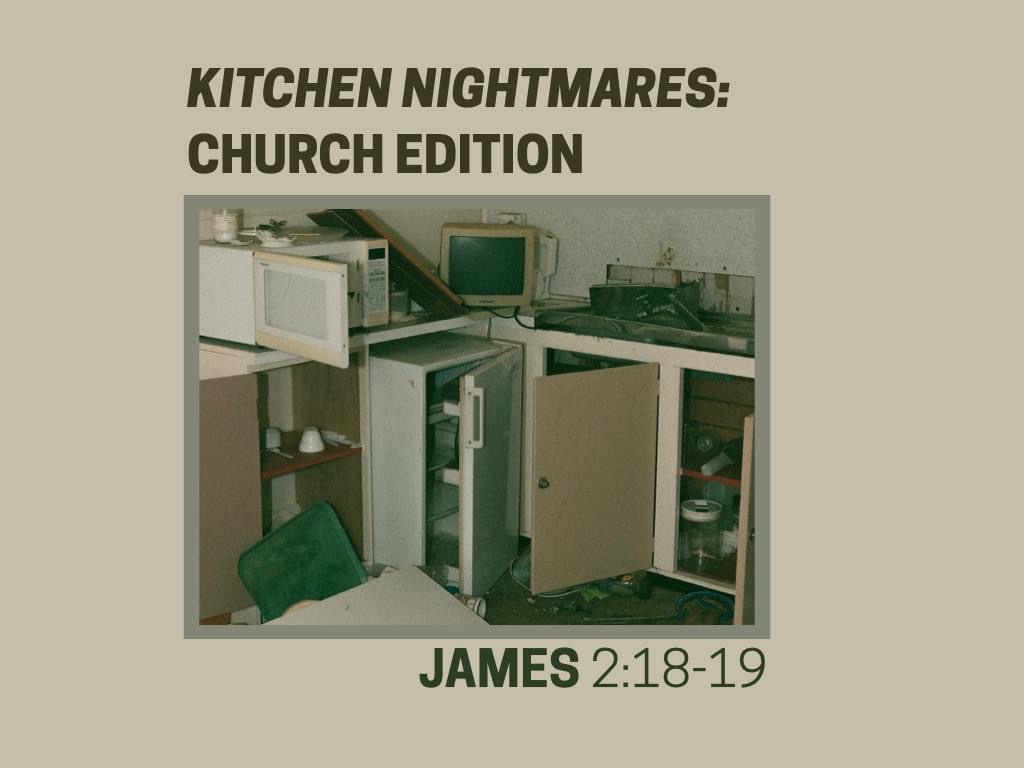
Confession time: I am a little addicted to “Kitchen Nightmares with Gordon Ramsay.”
If you’re not familiar with the show, here’s the premise. It’s a reality show where Gordon Ramsay—who’s this wildly successful chef and restauranteur— swoops in to try and save failing restaurants.
Because it’s reality TV, there’s a lot of drama and yelling and meltdowns and just plain silliness. And sometimes it’s just kind of like free therapy to see someone who’s not you getting yelled at.
Now, here’s something you’ll see like 99% of the time on “Kitchen Nightmares”: The chefs at these restaurants all claim to be gourmet cooks.
But then Gordon Ramsay comes and tries their food. And it’s awful. Or at best, it’s just really underwhelming. So he’ll call the chefs out, and tell them how bad their food is in the most colorful language you ever did hear.
And here’s the thing: They know going into this that Gordon Ramsey is a seven-star chef. But I’ve seen restaurants try and serve him rancid, rotten scallops. Potato chowder that tastes like glue. A grilled Caesar salad where even the romaine lettuce was grilled, worse: it was dirty. A thin crust pizza where the crust was tough as beef jerky.
These people claim to be gourmet chefs, and they have no clue why their restaurants are failing. So then Gordon Ramsey comes and eats their food, and he inspects their kitchens—and they’re filthy, the equipment is outdated, nobody’s keeping up with the food rotation in the freezer.
And he tells them, You advertise yourself as a gourmet chef, but the food you served me tells a very different story.
And we don’t just see that kind of thing on reality TV, do we? In every area of life, we’ve met people who write big money checks with their words that bounce when it’s time for action.
And that’s the problem James was addressing with the members of his church.
They showed up for worship. They bowed their heads in prayer. They sang along with the hymns. They might’ve even shouted a few hearty amens.
With their lips, they confessed faith in Jesus. But their lives—their attitudes and their actions—were telling a completely different story.
It was like James was playing the role of Gordon Ramsay on a reality show called “Church Nightmares.”
These people proudly claimed that they were gourmet chefs in the kitchen of faith. But when James tasted their religion, it was rancid and mushy and gross.
So James, the expert theologian and preacher, told these Christians what was wrong with their faith—and how to make it better.
So, let’s put on our lobster bibs and dig in to James’ gourmet teaching on faith.
Faith is shown by works (James 2:18)
Now remember, James was preaching to Christians who proudly proclaimed their faith in Jesus, but they weren’t doing what Jesus would’ve told them to do.
Now—having said that, and before we go any further, I can’t stress this enough: Your salvation does not depend on how well you follow Jesus.
And James would have said so himself. He a realistic preacher who absolutely knew that even Christians are going to sin. A lot.
Later on, in James 3:2, he says: We all stumble in many ways. Notice James said, we all stumble, which means he was including himself.
I don’t like to put percentages on these kinds of things, but I’m kind of speaking from personal experience. And I’ve found what I’m about to share to basically be the same with wise Christians who’ve counseled me, and other Christians when we’re swapping stories about our struggles. So I want you to mark this well, because I’m a preacher telling y’all this.
I can follow Jesus … like 20% of the way, 80% of the time. Sometimes I have really shiny moments where it’s better. But I’ve also had seasons where it’s just ugly.
Okay—looking around to make sure no one’s fainted. I didn’t hear any gasps, I don’t see anybody clutching their pearls. Because some people would want to argue that their numbers are way better than that. Or I’m going to need to be doing a lot better than that if I’m going to dare to preach.
But in 1 Timothy Paul calls himself the chief of sinners. A lot of people want to make that just be about his past life—but Paul said it in the present tense. Not just, I was the chief of sinners when I was a persecutor and a blasphemer; but, I am, right now, the worst sinner I know. That’s humility. That’s honesty. The more mature you are in Christ, the more clearly you see how sinful you actually are.
M point is, if Judgment Day came and our eternal destiny depended on how well we lived up to our WWJD bracelets—nobody would see heaven, and that’s a fact.
But James wasn’t flipping out because people in his church were still struggling with sin; or they weren’t holy enough; or they weren’t busy enough. It’s that the things they were doing were making Christ look bad before a watching world.
And when James called them out on it, they’d say: Well James, we’re saved by faith and not by works. I believe in Jesus! So why does anything need to change in my life?
That’s the problem James is up against. There were Christians who were hiding behind their profession of faith, and then living however they pleased.Listen to the first part of v18: [Slide 2] But someone will say, “You have faith, and I have works.” Show me your faith without works, and I will show you my faith by my works.
Now, I want you to understand—James isn’t pitting faith against good works here, as a way of salvation.
He’s saying, You have Christian A, who says he believes in Jesus, but he’s the kind of guy who’d unplug his granny’s life support to charge his phone. So Christian B says to him: Your “faith”—again, let’s put that in scare quotes—is about as worthless as a steering wheel on a mule.
Now, I want us to step back again, and be cautious. Good deeds are not necessarily evidence of faith in Christ. Unbelievers do good things all the time. In Christ’s day, the Pharisees had mountains of good works piled up all around them—they prayed, they fasted, they gave to the poor. But Jesus called them sons of hell and hypocrites and whitewashed tombs full of death and decay (Matthew 23).
So, no—good works are not infallible evidence of a living faith—but at some point, they’re all we have to show other people that our faith is true; and they’re the primary way that others—especially those who don’t already believe in Christ—are going to see what our faith is all about. That’s why Jesus told us to let your light shine in people’s presence, so that they may see your good works and glorify your Father who is in heaven (Matthew 5:16).
So James lays it down here, and mark his words well: Show me your faith without works—which you can’t do—and I will show you my faith by my works.
I love something Martin Luther said about this: We are saved by faith alone, but the faith that saves is never alone. What is it that Paul said? So now faith, hope, and love abide, these three (1 Corinthians 13:13). Faith is never alone, because when the Spirit awakens her in your heart, she goes and grabs her friends hope and love, and the three of them together go to work.
What even is a good work?
You know what I suspect our problem is when it comes to our works? It’s not the only problem, but it’s a major one. We don’t know what a good work is.
I think once we understood the works that God smiles upon, we’ll see a couple of things pretty clearly.
First, you’re going to find that you’re already doing a lot of things God would consider good works.
And second, where you find your works are lacking, you’re going to be able to maybe Marie Kondo your walk with the Lord, and travel a bit lighter, so you can pursue the works of God with a new joy and purpose.
The first thing you need to know about good works is that, in order for something to be a good work, God actually has to have told you to do it in Scripture. There are no good works except what God has commanded; and there are no sins except what God has forbidden.
That ought to be a huge relief to a lot of you. Because you will see a lot of folks who have an appearance of being really busy doing good works, and if you compare yourself to them, you’ll come away discouraged. The thing you need to ask yourself though, is: What has God clearly told me I need to be about in the pages of Scripture? I say start with the Ten Commandments; those don’t ever go out of style.
The second thing you need to know—but it’s really the most important—for a work to be good in God’s sight, it must be done in faith. And to put a finer point on it, our works must proceed from faith in Christ. Jesus said: This is the work of God: that you believe in the one he sent (John 6:29). Outside of Christ, all of the works we do are filthy rags and a steaming pile of dung—even the ones that are good on paper (Isaiah 64:6; Philippians 3:8). This is why Paul preached to being about the obedience of faith (Romans 1:5l 16:26). That is, our works are declared holy and acceptable to God because they proceed from faith in Christ.
Look, every religion—even the Church of Satan—preaches some mind of moral reform. And any old heathen can be a do-gooder. But Hebrews 11:6 says, without faith it is impossible to please God. (And yes, David Mills, I know there’s more to that verse, but you can’t say everything that needs to be said in one sermon—no matter how hard I try.) And Paul says: Everything that does not proceed from faith is sin (Romans 4:23). Even good works are sinful if they’re not done in faith.
So then—here’s the caution—James goes on to say that just as the body without breath is dead, so also faith without works is dead (James 2:26). And the same way that faith without works is dead, works without faith are damning. I’d rather go to heaven anonymously, than go to hell with a bunch of people bragging at my funeral about how good I was.
Third—and this is really, really crucial to understand—your work, that is your vocation, your career; your eating, your drinking, your sleeping; washing the dishes, changing the diapers, mowing the yard, kind words, holding open the door … the normal things we do in the course of taking care of ourselves and our families and the common welfare … God counts those as good works, and is pleased with them.
And that’s in the Bible. Ecclesiastes 9:7ff says, first: Go, eat your bread with pleasure, and drink your wine with a cheerful heart, for God has already accepted your works; and, Enjoy life with the wife you love all the days of your fleeting life. Work for your meals and your comforts and gratefully enjoy them with your family. God is pleased with that. He accepts that as good works. Then it says: Let your clothes be white all the time, and never let oil be lacking on your head. Your garments are white when you are confident that God approves you and your efforts. Then you always have the oil of a happy conscience on you.
See, there’s not different classes or levels of good works, where God counts praying and fasting and reading the Bible and going on mission trips as somehow more holy or virtuous than putting food on your family’s table or being faithful to your marriage vows.
God never makes that distinction in Scripture. There will be plenty of people who prayed like an angel and sat atop mountains of righteous-looking accomplishments, and on Judgment Day, Jesus will tell them: I never knew you. Depart from me, you evildoers (Matthew 7:23). But then there will also be many people who lived faithfully quiet lives, and Christ will tell them: Well done, good and faithful servant! You were faithful with a few things. I will put you in charge of many things. Enter into the joy of your master (Matthew 25:21).
And the only difference between them will be faith in Christ. Psalm 2:12 says: Blessed are all they that put their trust in him. Christ will establish the works of their hands, and quickly forgive their failures, and work all things together for their good.
Now you can know what God accepts as a good work, so you can be confident in what you do. As long as what you do is something God has commanded and blessed; and it proceeds from faith in Christ—it is a good work. So whether you eat or drink, or do anything else, do everything to the glory of God (1 Corinthians 10:31). That way every meal you prepare or eat; every diaper you change; every boo boo you bandage; every person you let go ahead of you in the grocery store—along with every prayer, every moment studying Scripture—as long as they’re done in faith, they are done to the glory of God, and He calls them good.
Here’s the beauty in that. Once you understand good works the way I’ve just laid out, it brings a dignity and purpose and a true freedom to whatever you do. It sets you free from all performance anxiety before God and man, because faith in Christ means you’ve given up trying to be impressive. You realize that you don’t have to look around for good to be doing. You’re already doing it.
And the thing is, faith in Christ is not a dead faith, James says; it is a living faith. And so it’s breathing, it’s active, it’s joyful. Faith doesn’t even ask what good works there are to be done. Because faith has grabbed onto Christ with one hand, and grabbed hold of you with the other. And the longer you walk in faith, your eyesight will be enchanted, so that you will see all sorts of good to be doing, and you will just do it. It will be like a child when she sees a swing set—nobody has to tell her to run to it and swing, she just does. And that’s how faith in Christ provokes us to good works.
Just remember what it says here in James 2:18: Show me your faith without works, and I will show you my faith by my works. You’re not doing good works to be justified before God. The Lord knows those who are his (2 Timothy 2:19). You don’t have anything to prove to Him. And the only work that’ll justify you in His sight is Christ’s work. But no one else will ever see that your faith is true except by what it leads you to do. Again, as Martin Luther said: God doesn’t need your good works, but your neighbor does. We show them our faith by our works.
Even the demons believe, and shudder (James 2:19)
I wish I had more time to talk about v19, because just like the rest of James 2, people—especially lazy preachers —take this verse places James didn’t mean for it to go.
So, v18, James was basically saying: How would I know you have faith in Jesus? Because you get warm fuzzies when we sing ‘Light the Fire’? But are your warm fuzzies warming up anybody else?
Now in v19, James says: You believe that God is one. Good for you! Even the demons believe that—and shudder!
So listen, the reason I say we need to be oh-so-careful with how we wield this passage is that it’s not meant for timid believers; or to kickstart a congregation that’s maybe a little lackluster. It’s not for Christians who are struggling with a besetting sin.
This verse is a cattle prod, okay? But when you have a sister or brother who’s struggling, who’s weak, who might have a tender conscience, who may lack assurance—please don’t compare them to a demon.
No: We who are strong have an obligation to bear with the weaknesses of those who are not strong (Romans 15:1). If I ever catch you breaking a bruised reed or snuffing out a smoking wick—that’s what Jesus calls those who are struggling and weak and tender (Matthew 12:20)—then you’ve just showed me by your works that you don’t actually have any faith in Christ.
But this verse is a cattle prod for those who need one. And it’s saying, Faith is more than believing true things about God. Now, that doesn’t mean that we don’t have a duty to learn and believe true things about God. That’s loving God with all your mind, right?
But faith also loves God with the heart—that is our will and affections; faith loves God with the soul—that is in faith we desire God’s reign over all of our lives; and faith God loves with our strength—that is, our work, our efforts, our abilities.
So James is saying that even demons believe there is One God, the Triune God: Father, Son, and Holy Spirit. I mean, obviously they believe it, since God personally evicted them from heaven.
But the real difference between a struggling, sinful Christian—and that’s all of us—and a demon, is this. Both the demon and the Christian believe true things about God; but only the struggling Christian has her eyes fixed firmly on Jesus for salvation.
She knows that her only hope in life and in death is that she belongs body and soul, in life and in death, to her faithful Savior, Jesus Christ.
A demon does not have that comfort. A demon is not clinging in faith to Christ alone for salvation. A demon sees Christ, and can only tremble at the judgment they know is coming for them. If you have faith in Christ, you don’t have to tremble at the mention of His Name.
You know, I started out talking about the show “Kitchen Nightmares.” And that’s how I’m going to bring us to the end of the message now.
On “Kitchen Nightmares” remember, you had people boasting about being gourmet chefs, but when Gordon Ramsay tastes their food—it’s awful.
A lot of times, it turns out that all their talk about how great their cooking is, was really empty boasting. Those chefs are often fired by the end of the episode.
But a lot of times what you see is—yes, these people have the skills, they have the training, and they’ve been successful chefs in the past.
And what’s happened is, because of all the stress and pressures of life and money and running the restaurant, they’ve lost their joy and passion for cooking.
That can happen for Christians, too, with our faith. We can get beaten down and disillusioned, we can lose our focus. We can get distracted. Because we’re struggling with life stresses, with health issues, with mental and emotional challenges.
You know you have faith in Christ, but it’s not exactly blossoming with a bountiful harvest of the fruit of the Spirit right now. It’s happened to me. Maybe that’s where you’re at right now, too.
What you do in that situation is—you keep your eyes fixed on Jesus Christ, the author and perfecter of your faith (Heb. 12:2). Self-examination is good and necessary. 2 Corinthians 13:5 says: Examine yourselves to see if you are in the faith. And once you see that faith is indeed alive in you, you turn your eyes to Christ, who died for you and now sits at the right hand of the Father, praying for you. For every one look at yourself, you need to take about a dozen long gazes at Christ.
When it says Christ is the author and finisher of faith, it means that he who began a good work in you will carry it on to completion until the day of Christ Jesus (Philippians 1:6). That’s a promise. He’s able to save you completely because He’s praying for you, right now, that your faith may not fail (Hebrews 7:25). The one who calls you is faithful, and he will do it (1 Thessalonians 5:24).
And I tell you this because our works depend on Christ, because our faith depends on Him. He is the Vine, we are the branches, and good works are the fruit He produces in us. And our Vine tells us: The one who remains in me and I in him is the one who bears much fruit, because without me you can do nothing (John 15:5).
With that in mind, here’s an action item I want to leave us with today—an exercise to examine ourselves, and then look to Christ.
Gratitude and hope [1]
Let’s make ourselves two prayer lists. Call one list Gratitude. And call the other list Hope.
The Gratitude list is where you can see clearly how God has given you grace in Christ, and you have already produced good fruit. You can start with the fruit of the Spirit. How have you grown in love for God and your neighbor? Is there joy and peace that you have now, that didn’t used to be there? What about patience, kindness, faith, gentleness, and self-control? What are you doing differently than you used to because of this growth—that you can see, and other people can see?
Even if you find that your fruit is still a bit puny; or you only find tiny little buds blooming—thank the Lord for it! Don’t despise the day of small beginnings, but rejoice in it, and be grateful. Because that’s the fruit of the Spirit, not the fruit of you. This is faith producing good works.
The list of Hope will be where you examine yourself and see areas where you need to grow. It can be in the fruit of the Spirit, or in the Beatitudes, or the Ten Commandments. But it can also be about specific work you feel convicted to do, or change you need to make in your life. Maybe you need to be more patient with your kids, or you want to be able to share the Gospel with unbelieving neighbors. Maybe it’s as simple as knowing you need to be more engaged with the church—like coming to Sunday Bible classes, or Wednesday night food and fellowship. Pray for God to intervene, to turn your heart to what is good, and true, and beautiful. For Christ to wear you as a mask and love others through you.
And both lists can just keep growing, see? Because we’ll always have areas where we can grow in faith and in love. But as we grow, we’ll have new reasons to celebrate, and praise God for His faithfulness producing good works in us.
[1] This exercise was suggested by Daniel Doriani, James, Reformed Expository Commentary (Phillipsburg, NJ: Presbyterian & Reformed Publishing, 2007), 88.
 the sermonator