

The other day, I posted this off-the-cuff observation on social media.
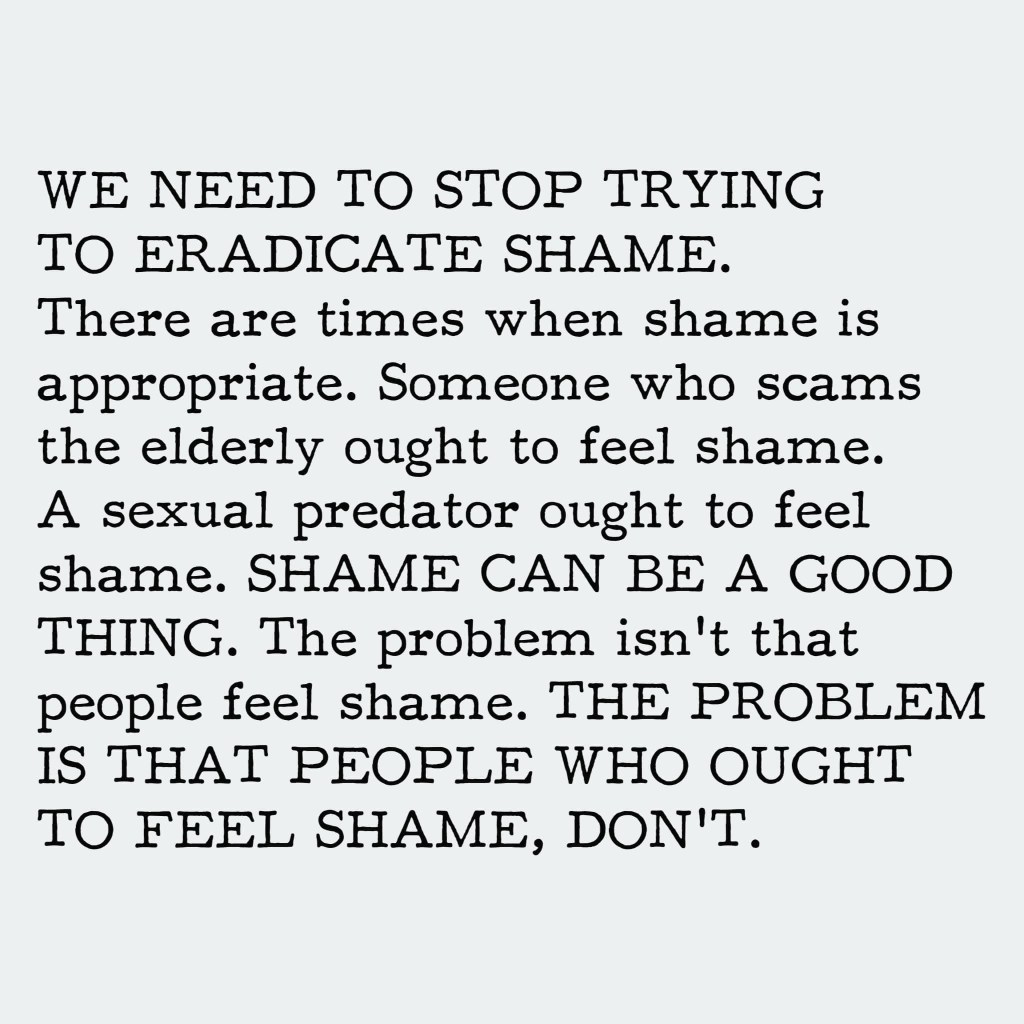
It got some pushback, mostly in terms of how we understand and define shame.
Much of the issue here is semantics. Modern psychologists, philosophers and ethicists have redefined the concept as, essentially, feeling vaguely bad about yourself, feeling unworthy, and / or internalizing your mistakes.
This definition of shame has been popularized especially by Brené Brown, who writes: I define shame as the intensely painful feeling or experience of believing that we are flawed and therefore unworthy of love and belonging—something we’ve experienced, done, or failed to do makes us unworthy of connection.
But historically this is not how shame has been defined. Aristotle, for example, viewed shame as semi-virtuous. That is, he did not believe shame is itself a virtue; but it can be put to a virtuous use. This more positive view of shame can be seen in the following examples.
Whilst shame keeps its watch, virtue is not wholly extinguished in the heart.
Edmund Burke, Reflections on the Revolution in France
Where there is yet shame, there may in time be virtue.
Samuel Johnson, Journey to the Western Islands of Scotland
Brown’s definition of shame denies that it can ever be put to a godly or virtuous use. However, her definition only holds true if we divorce the concept of shame not only from its etymology, but from its historical conceptions. This especially holds when we unhitch it from its traditional use: in service to, and in combination with, civic and moral virtues.
I am writing in defense of shame; and specifically, to retrieve and recover it for virtuous and godly uses. For divorced from identifiable civic and moral virtues, it does indeed tend to become morbid and toxic, having nothing to attach itself to. Thus the only place it can lead us to is despair and paralysis. This outcome is actually what thinkers like Brown are observing and acting against. They believe shame is itself the problem. I would argue that the real problem is that we live in a time where virtue is neither known, nor honored, nor taught. Once we return shame to its proper work within a framework of virtues, we will find that it may not only be redeemed; but itself have redemptive value.
The historical definition and use of shame
The English word shame originally meant either the painful feeling of guilt or dishonor; or the thing that actually caused the dishonor. It came from a Germanic word related to blushing, which itself probably came from an Old Norse root word related to covering your nakedness. Incredibly striking visual, isn’t it?
The ancient Greeks saw shame as a spectrum, with two different words on either end. On the one end was aischynē, which meant disgrace or dishonor. On the other end was aidōs, meaning modesty or bashfulness. The latter was considered positive—a person who felt such “shame” was virtuous, with a robust conscience. They were sober, circumspect, and self-controlled. The former, of course, was negative—you felt it because you had behaved in an unvirtuous manner. Your clay feet had been exposed, resulting in a loss of social status.
Another way of looking at it is an appropriate sense aidōs will save you from committing deeds that bring aischynē. Reflecting on the virtues, Aristotle proclaimed that aidōs would always prevent a good man from doing evil, but aischynē might sometimes even restrain an evil one. In other words, even a man who cannot blush may sometimes be restrained from evil by the fear of losing status in the eyes of others. In that regard, even aischynē has historically been understood to have a positive function in maintaining social order.
Shame in the New Testament
Scripture is not above leveraging shame [aischynē] as a means of moral censure. For example:
But what fruit were you getting at that time from the things of which you are now ashamed [epaischynesthe]? For the end of those things is death. [In this compound word, the prefix epi intensifies aischynō, by singling out the personal nature of the disgrace]
Romans 6:21 ESV
Instead, we have renounced secret and shameful [aischynēs] things …
2 Corinthians 2:4 CSB
For it is shameful [aischrós] even to speak of the things that they do in secret
Ephesians 5:12 ESV
They are wild waves of the sea, foaming up their shameful [aischynas] deeds …
Jude 13 CSB
On the other hand, we see aidōs commended, as in 1 Timothy 2:9:
In like manner also, that women adorn themselves in modest apparel, with shamefacedness [aidōs] and sobriety; not with broided hair, or gold, or pearls, or costly array
KJV
In other words, to adorn herself with virtue and propriety, rather than gold and finery.
So we see that Scripture uses the concept of shame in the same kind of way we see it in Aristotle. It tends towards virtuousness.
Mere shame vs. Toxic shame, with some help from Joan Didion
So when I say we shouldn’t be so quick to eradicate shame, I don’t mean the toxic kind. That can and should be put away because it does nobody any good. But not all shame is toxic. And historically, wise and godly folk have understood this. Aristotle and St. Paul certainly did.
A virtuous person is one who is able to blush at the appropriate things. But again: even an unvirtuous person might be constrained from evil by the discomfort of shame, that is, the fear of being demoted in the opinion of others.
The perfect love of God in Christ will surely cast out the toxic shame that cowers and shrinks back. But as to shame in the more general sense—both on the aidōs and aischynē ends of the spectrum—there’s value to it, morally and socially. There’s something vulnerable, necessary, and authentic about—in the words of Joan Didion—being a willing audience of one to an interminable documentary that deals with one’s failings, both real and imagined, with fresh footage spliced in for every screening … counting up the sins of commissions and omission, the trusts betrayed, the promises subtly broken, the gifts irrevocably wasted through sloth or cowardice, or carelessness.
To be unable to blush or wince at these is to be dishonest about our own sinfulness, and thus rendered unable to be repent and be forgiven.
Toxic shame is to mere shame as toxic masculinity is to mere masculinity. There are indeed toxic ways that many men exercise their maleness. We ought to be able to condemn the one while recognizing the good and natural use of the other.
Whether our shame is toxic or not can only be seen in its fruits. Both Judas and Peter turned on Christ—Judas in a more dastardly way than Peter. But both betrayed Him in an intensely personal manner. Judas went out and hung himself. Peter wept bitterly, but eventually returned and was forgiven and reinstated to ministry by Christ. St. Paul, I believe, had this sort of contrast in mind when he wrote: For godly sorrow worketh repentance to salvation not to be repented of: but the sorrow of the world worketh death (2 Corinthians 7:10 KJV).
Let’s go back to Joan Didion’s meditations on watching that internal documentary of our failures and sins. She concludes that we eventually lie down alone in that notoriously uncomfortable bed, the one we make ourselves. Whether or not we sleep in it depends, of course, on whether or not we respect ourselves.
Of course, as a Christian I am with her up until that very last clause. I can sleep at night, not because I “respect myself,” but because Christ has borne both my sins and the shame of them on the cross. It is because of what He has done that I am able to own not only my sins, but my moral injuries, and the sins of others against me, and still go on. By the historical definitions of shame—pregnant with nuance and delightfully contoured—I have a litany of very good reasons to blush, to be uncomfortable, and frankly, to despair.
I confess with the Apostle that in me (that is, in my flesh,) dwelleth no good thing (Romans 7:18 KJV). And with him, I cry out: O wretched man that I am! who shall deliver me from the body of this death? (Romans 7:24 KJV). “Wretched man that I am,” is not merely a word of guilt or contrition. It is not merely that I have made bad choices or done bad things.
When I confess that “in me dwelleth no good thing;” and cry out that I am a “wretched man,” I am declaring that I cannot put a wedge of daylight between what I have done and who I am,
I cannot truthfully say of my sins, as we often hear in the non-apologies that litter our unvirtuous wasteland: But these behaviors don’t really reflect who I am. They absolutely do! I am not a sinner because I sin; fundamentally, I sin because I am a sinner. To not be ashamed of myself in light of that would be stunningly (to me, at least) lacking in either self-awareness, honesty, or both.
The problems with the modern redefinition of shame
I want to finish by referring again to something Brené Brown says in her definition of shame: that something we’ve experienced, done, or failed to do makes us unworthy of connection.
I feel the need to point out some serious problems with this definition of shame in light of what we have observed so far about how people have historically understood shame; and offer some suggestions for a way through.
First, Brown fails to distinguish between what we have experienced—that is, things done to us; and things we’ve done or failed to do. This is the difference between a moral injury or trauma; and words, thoughts, or deeds for which we perhaps ought to actually feel objectively ashamed.
She also fails (at least here) to distinguish between aidōs—shame before the fact; and aischynē— shame after the fact.
Moreover, she does not mention mitigating factors. For example did you act in ignorance when you did the things for which you later feel ashamed? Was your failure to do based on ignorance or lack of opportunity; or did you just stand around and watch a three year old drown? If your doing or not doing was from cowardice or malice, why ought you not feel shame?
Arguing merely that it’s unproductive is not in itself a valid apology for a wholesale abandonment of shame. That smacks of a sort of pragmatism or consequentialism that stands in opposition to virtue—that certain things are right because they’re right. Simply because many experience shame wrongly is no argument that shame is bad. Imagine arguing that about justice or mercy. Because our justice system is corrupt, we should abandon the desire for and pursuit of justice. Or, Because many abuse mercy, we should stop being merciful.
In fact, it’s because we live in a society where virtues are neither named, nor intentionally taught, nor modeled. Our laws, customs, and mores are likewise increasingly arbitrary and capricious. These are the reasons why shame is largely disordered, so that people are either deficient in it; or it goes septic in them because there’s nothing objective to attach it to. I’m reminded again of some Joan Didion stated in one of the quotes above, about the interminable documentary that deals with one’s failings, both real and imagined, with fresh footage spliced in for every screening (emphasis added). Perhaps a major reason we suffer from disordered shame is that we don’t know how to distinguish between real and imagined moral failures.
I’m reminded of something that St. Paul said in his Epistle to the Romans:
For when Gentiles, who do not have the law, by nature do what the law requires, they are a law to themselves, even though they do not have the law. They show that the work of the law is written on their hearts, while their conscience also bears witness, and their conflicting thoughts accuse or even excuse them.
Romans 2:14-15 ESV
Without a stable, objective moral law and set of conventions that flow from it, what are we left with but a conflicted conscience that here excuses, here accuses us, on the basis of what? Popular opinion? The latest scientific theory? Something we heard on Oprah?
Likewise, a retrieval of historical virtues may help us with our disordered shame. The virtue of humility—which allows us to see ourselves as we truly are before God—will lead us to bring our shame to Christ for healing, and bear fruits worthy of repentance. The virtue of magnanimity will disciple us away from pettiness and cowardice, and towards generosity and noble acts. Toxic shame does not long thrive in the soul that is not turned inward on itself.
Likewise, contra Brown, it seems obvious to me there are things that people do, and more importantly are, that make them “unworthy of connection.” We could also translate that to “a danger to others” and “unfit for society.”
Even Jesus acknowledged this, bluntly. Of those who prey upon children, He said: it is better for him that a millstone were hanged about his neck, and he were cast into the sea (Mark 9:42 KJV). That language is only mildly hyperbolic. For He goes on to command that they should be amputated from the body (Mark 9:43-48), because their ongoing presence is just going to make hell for everyone else.
Christ never envisions a happy ending where wolves turn into sheep. They are unable to blush, so those of us who can blush must take measures to protect ourselves and others from them. If we fail to do so, it is to our shame.
Now, if you’ve read this all the way to the bottom, you might be wondering: But if the nuances of the word have changed, then why not go with the accepted popular definition?
I hope I have shown why the currently popular definition of shame is deficient, too narrow, and based upon faulty premises.
What many fail to grasp is that the one who controls the dictionary and lexicon of life—the one who controls the definitions of things—controls the agenda and direction of the culture. Perhaps we need to take a closer inspection of who’s rewriting the cultural lexicon; and why; and asking ourselves why we’re letting them?
 the sermonator