
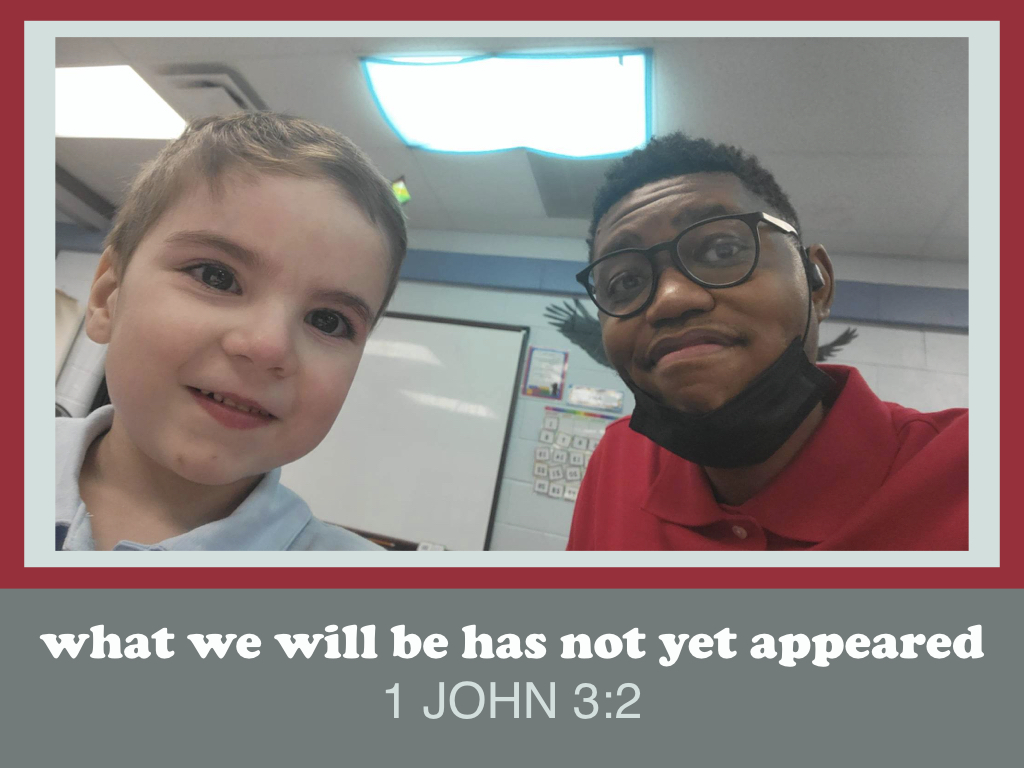
This post is the manuscript of my sermon at Brooks Avenue Church of Christ in Raleigh, NC for April 30, 2023. We have a special needs ministry at Brooks, which my own three-year-old son August is served by. After a three-year break due to COVID restrictions, the annual Special Needs Carnival returned to Brooks this year, serving several hundred special needs families. This message was preached the next day, during a unique service led by people from our special needs ministry.
You can watch the service here on YouTube. My preaching picks up at 25 minutes in.
Defining the Imago Dei
Today we’re celebrating our friends and family members with special needs. So the message is focusing on the image of God in people with disabilities—especially those with profound cognitive disabilities. But there’s hope for every Christian in what I want to share, because all human beings are in the image of God; and every believer is waiting for the same resurrection, when our bodies will be completely healed.
Our Scripture for today is 1 John 3:2. Beloved, we are God’s children now, and what we will be has not yet appeared; but we know that when he appears we shall be like him, because we shall see him as he is.
No matter what our condition is now—when Jesus returns, whoever believes in Him will be made like Him. No one will be raised with any disabilities or limitations or weaknesses. We will be like Him—immortal, imperishable, and incorruptible.
And if we with able bodies and minds hope for this day, imagine how amazing it will be to see what our friends who in this life are called disabled or challenged will become in eternity.
So the very first thing the Bible tells us about ourselves is that we are Imago Dei—that is, in the image of God. Genesis 1:26, on the sixth day of creation, God says: Let us make man in our image, after our likeness. And let them have dominion over the fish of the sea and over the birds of the heavens and over the livestock and over all the earth and over every creeping thing that creeps on the earth.
Now, here’s something interesting.It tells us that humans were made in God’s image, but doesn’t actually say what that means. How are humans in the image of God?
So, there’ve been various attempts to answer that question throughout church history.
And those answers tend to fall into two basic categories. The image of God is either a quality or capability that humans possess; or a function that we fulfill.
Those who say that it’s a quality we possess usually argue that is found in the life of the mind. In our reason and intellect. We possess a rational mind, a morally responsible will. We have the ability to plan for the future, to make choices, and follow through on them. We are self-aware and self-directed.
Still others notice that God says, Let us make man in our image. This is the Triune God speaking: Father, Son, and Holy Spirit. And so they believe the image of God to some form of triunity in humans. For example, Augustine believed that the image of God has to do with the threefold nature of our inner lives. We have a memory, an intellect, and a will.
Now, others have argued that the image of God is not a quality or ability we possess, but a function we were created to fulfill. And this idea has become rather popular more recently.
People who think the image of God is a function we perform are looking at the second part of Genesis 1:26, where God says He’s making humans in His own image so that we can take dominion over the earth and the other creatures.
According to this idea, we express the image of God as we perform dominion-taking activities. When we wash the dishes or mow the grass or plant a garden or work at a trade or create art and build civilizations, the image of God comes to life in us, and is realized.
So this way of understanding the image of God says it’s less something we have or something we are—it’s more of something we do. We become like God as we care for the world around us, and as we make it work for us, and bend it to our will. We prune branches, we write laws, we convert wind into electricity. That is the image of of God.
Well, a few years ago a seminary student named George Hammond said, You know, there’s a problem with all these definitions of the Imago Dei. Because many, many people are left out if these are what it means to be in the image of God.
And what made George Hammond see the problem was his own daughter, Rebecca, who has a severe disability called Angelman syndrome. Rebecca is non-verbal—she doesn’t talk. She barely acknowledges anyone else, and is mostly in her own world.
Here’s how George Hammond describes his daughter’s life. Bear with me, I want to read this so that more people get a good flavor of it. And remember, this is a father speaking about his daughter. This is not clinical detachment. This is heartbreaking sobriety from a parent who has had to adjust all of his hopes and dreams for his child.
The activities she busies herself with are not productive. Her undertakings are not a help, they simply cause more work. Rebecca has no idea where her food and clothing comes from. She is helpless to do anything to care for herself; to get food or drink, to get dressed, to get washed, to use the toilet. She accepts all of these things without gratitude, and without any discernible cognizance that they are provided by the love of others … Existence in her own world without too much acknowledgement or regard for others. An expectation that she and all her needs will be taken care of, without gratitude, and in fact with frequent complaining on her part.
It Has Not Yet Appeared What We Shall Be: A Reconsideration of the Imago Dei in Light of Those with Severe Cognitive Disabilities, Reformed Academic Dissertations, ed. John J. Hughes (Phillipsburg, NJ: P&R Publishing, 2017), xxvi
Some of us live with those cold, hard facts. We love our children. They bring us joy. You better not mess with them. But we have long ago accepted that they, and we, face many challenges that others simply do not.
Now, what George Hammond saw because of Rebecca is that the standard definitions of the image of God exclude people like his daughter, who have profound cognitive disabilities like Angelman Syndrome or severe autism, or those who have suffered severe brain damage.
So he wrote a doctoral dissertation about it. And because I am the parent of a child with special needs from myself; and also minister; and also because I’m just a nerd—I read it. So Hammond’s thoughts have greatly influenced how I think about this, and what I’m going to share today.
The image of God damaged but not erased by the Fall
Basically, if we understand the image of God as a quality we possess or a function we fulfill, what does that mean for people who don’t possess those qualities, or who don’t perform those functions?
That is the question. If someone does not meet a certain arbitrary level of self-awareness, or ability to reason; if they can’t even feed or dress themselves, much less take dominion by working at a job—can we still say that they are in the image of God?
And if they’re not in the image of God, does this make them somehow subhuman? Instinctively, we know this is not the case. The Nazis called disabled persons “useless eaters.” But Christians know better.
So here’s how we need to shift our thinking. The image of God is not related to our abilities. It’s not a quality we possess, or a function we fulfill. Human beings are the image of God because He declared it so at creation. In other words, we are God’s image by divine fiat.
To say the image of God is a quality we possess—like self-awareness, or intelligence, or communication; or a function we fulfill—like planting gardens, painting pictures, or building civilizations—is actually getting it backwards.
It is because human beings are in the image of God that we are able to think, and speak, and take dominion. But those things in themselves are not the Imago Dei. Possessing those qualities or doing those things doesn’t make us human.
So here’s how we should think about it. The image of God is a potential God created us with, that has not yet been fulfilled. And that’s not just true for our loved ones and friends with various disabilities. That’s true for every son of Adam and daughter of Eve.
Look at it this way. When God finished the work of creation, the Bible says that He saw everything that he had made, and behold, it was very good (Genesis 1:31).
Notice that: Everything was very good. But not perfect.
The creation—including the human creature—was completed, but not consummated. There were still seeds to be planted, wells to be dug, minerals to be discovered. Humanity itself had to grow into taking dominion. There was knowledge to be gained, plans to make, and much work yet to do.
Now, when God called the first humans very good; and He called all creation very good—there was no death. No disease. No disability.
God placed us in His Garden in Eden, where there was the Tree of Life, whose fruit would cause you to live forever. So there was nothing standing in the way of humans learning and discovering and taking a peaceful dominion over our world. There was only one limitation—the Tree of the Knowledge of Good and Evil. How many of you know this story?
Now, what would have happened if Adam had not sinned—if he had resisted the serpent’s temptation, and not eaten from that one tree—is that eventually he and his children would have filled the earth, making it all like Eden. And God would have granted us immortality and glory.
God may as well have spoke the words Revelation 2:7 to Adam: To him that overcometh will I give to eat of the tree of life, which is in the midst of the paradise of God. The image of God would be consummated; transformed from very good to perfect. Fit to dwell with God, in His glory, world without end.
But when Adam fell into sin, very bad things—like disease and disabilities and death—were unleashed on God’s very good creation. And part of the very bad is that sometimes—whether from birth, or disease, or accident; there are people who live with no idea where their food and clothing comes from. Who are helpless to do anything to care for themselves: to get food or drink, to get dressed, to get washed, to use the toilet. And who are unable to express any gratitude for receiving those things.
The image of God has been frustrated by the Fall, and corrupted by sin. It has twisted our intellect, our will, our words, and our deeds. It also twisted our bodies, and even our very DNA.
But it has not been lost or destroyed. We all still bear it. If I paint a Groucho mustache and glasses on the “Mona Lisa,” it’s still an image of “Mona Lisa.” Only defaced.
So the image of God has not been erased. It’s still there in all of us. But it has not yet been consummated. We just notice it more in those with disabilities. But every one of us—even the strongest and wisest and most capable—is going to have to be transformed before we’re fit for eternal life, you see. You no less than them.
The image of God restored and perfected in Christ
Now, all of this should lead us to see that we cannot save ourselves. We are as helpless at getting ourselves fit for glory, as George Hammond’s daughter Rebecca is at making her own dinner.
Living in a world with such futility—and realizing that our own undertakings are often unproductive; in some ways we all take more than we are able to give back—should drive us to look for, and long for a Savior. Who will deliver us from this body of death? (Romans 7:24)
The Bible’s answer to that question is Jesus Christ. Who will deliver me from this body of death? These flimsy bodies that are prone to grow old, break down, and wear out. These bodies that are sometimes even born with marks of the Fall on them. Who’s going to save us from all this? Thanks be to God through Jesus Christ our Lord!
Because we bear the image of God, God can and will and is redeeming that image—because it is His. His purpose for humanity will not, must not, and cannot be thwarted by sin, Satan, and death.
Jesus Christ came to restore the image of God in us that was marred by the Fall; and then to consummate it. To bring us into eternal life and glory with God.
And He did that, first, by perfectly joining Godhead and Manhood in Himself. He is true God and true Man. As God, He is the eternal Son. As Man, He is Jesus Christ, the Son of David, with a real human body that was susceptible to hunger and suffering and even death. He took on flesh—our very flesh—and came to us, to restore the image of God in us.
Colossians 1:15 says that Christ is the image of the invisible God, the firstborn of all creation.
He is the image of God—the perfect image of God, everything God intended mankind to be—in His incarnation. He is the firstborn of all creation in His resurrection.
Here’s how it works.
After the Fall, we had to leave the Garden. We were not fit to live in the presence of a holy God. What’s more, we lost the right to eat from the Tree of Life, which gives immortality.
That was a blessing, you see. Because who wants to go on living forever with your body, soul, and spirit all twisted with sin and sadness?
We lost the right to dwell with God, but God came to dwell with us in the human body of Christ. And by His life, he showed us the true image of God, as a Man. By His death, He bore God’s anger at His image defiled and corrupted by sin. And in His resurrection, God has promised to make us glorious, like Christ.
You see, even earthly children bear the image of their Father. And when we are joined to Jesus, God’s only begotten Son, we become sons and daughters of God through Him. And the Holy Spirit immediately gets to work, restoring the image of God in us. 2 Corinthians 3:18 says that those who believe in Christ are being transformed into [His] image from one degree of glory to another.
In Christ, the image of God that was defaced and deformed by the Fall is being restored in all those who believe in Him. And when He returns—that image will be perfected. Better than very good. Perfect.
Jesus will raise us just as He has been raised—glorified. Immortal. Imperishable. Incorruptible. No pain. No suffering. No disabilities. Not less human, not less real—but more real and more human than we have ever been.
He is rescuing us from these bodies of death, you see. All of us—disabled or not.
Resurrection: Hope for all of us
So what does all this mean for those we love who have special challenges and disabilities—especially profound ones?
Ah, I wish I had more time to talk about the faith of those who have cognitive challenges—even those who are nonverbal. If you love someone in that state, I bet you know it’s there.
Some cynic might ask: But how could you ever know?
I say this: In Luke 1:44, when Mary was pregnant with Jesus, she went to visit her cousin Elizabeth, who was six months along herself, with John the Baptist. When Mary came near, bearing Christ in her womb, John began to leap and dance in his mother’s womb! If the Holy Spirit can create faith in a baby in the womb, He can definitely do it in your nonverbal loved one.
Every work of regeneration is God’s work. Faith is always the gift of God, Ephesians 2:8-9. God regenerates the heart and soul before He resurrects the body. Our hearts are first made fit for heaven; then when Christ returns, finally our bodies.
But oh, do bring them to Christ! The ones who don’t talk, the ones who groan and shout, the ones the world considers inconvenient.
Bring them to Him in prayer, yes! But also bring them to Him through His people, His body on earth, the church! Like the men who dropped their paralyzed friend before Jesus, through the roof—bring your children to Jesus and He will minister to their soul. And when Christ returns, we are promised that He shall change our vile body, that it may be fashioned like unto his glorious body (Philippians 3:21).
That’s wonderful news for those with disabilities and those who love them. Because it means that every accident of birth, every brain injury, every twisting of the body will not only be set right and made very good; it means they will be perfected. Perfectly conformed to the image of Christ. The image of God not only restored, but fulfilled. Surely we have gained more in Christ than we lost in Adam!
And that brings me back to the passage we heard at the beginning. 1 John 3:2: Beloved, we are God’s children now, and what we will be has not yet appeared; but we know that when he appears we shall be like him, because we shall see him as he is.
If you have put your faith into Christ alone for your salvation, you are already God’s child now. Your child or loved one who may have the most profound disabilities is likewise God’s child—they bear God’s image. We are longing for it to be restored and corrected. Not only those who suffer the most visible challenges and disabilities—but in all of us.
It has not yet appeared what we shall be, but we shall be like Him—like Christ glorified, immortal, imperishable.
When it says what we shall be has not yet appeared, it doesn’t mean we have no idea what resurrection will be like—we see the resurrection of Christ in Scripture. John himself saw the resurrected Christ, touched Him, ate with Him. It just means it hasn’t happened for us yet. You don’t get a resurrection body as soon as you believe and are baptized. You still struggle in your mortal body. Your loved one who is disabled still lives in their body with its limitations. But we shall all be made like Him together.
That should give us all hope, because it proves that salvation truly is by grace alone. Think of Christ saving someone the fools of this world scorn as unproductive, and who cannot perform great deeds of faith or stand before God with a pile of good works. And they are just as saved as you are, and you are just as saved as they are. If that offends you, you have not understood the Gospel. For the Gospel proclaims that it does not depend on human desire or effort, but on God’s mercy (Romans 9:16).
You look at the person who’s nonverbal, whose body is contorted by seizures and palsy; or even someone whose mind will never advance beyond the age of six or seven; and you understand—you have no more to offer God than that person does. Indeed, those among us with what we call “special needs” may be the most important people here, for that very reason—they keep us humble.
But now for something to lift up your own head, and to hopefully transform how we interact with one another in the church; and with those outside the church who likewise bear God’s image. Because we want them to be drawn to Christ, in hope that they too, will be made like Him along with us. First in their soul, then in their body.
In his essay “The Weight of Glory,” C.S. Lewis reminds us what it means when it says we will be like Him:
The load or weight or burden of my neighbor’s glory should be laid on my back, a load so heavy that only humility can carry it, and the backs of the proud shall be broken. It is a serious thing … to remember that the dullest and most uninteresting person you talk to [and let me add, even the person who now is unable to speak, J.M.] may one day be a creature which, if you saw it now, you would be strongly tempted to worship.
The Weight of Glory and Other Addresses (San Francisco: HarperCollins, 1949, 1980), 45.
So beloved, let’s start interacting with others as though we really do hope—and even expect—that God shall indeed make them as Christ is, perfecting His image in them. After all, love hopes all things (1 Corinthians 13:7). And for those here who love someone with special needs—you know the hopes you have for your child, your sibling, your friend. Don’t stop hoping. Like D.A. Carson has said, there’s nothing wrong with any of us that a little resurrection won’t cure.
If you find that the Holy Spirit has brought faith to life in you today, now is the day of salvation. When you put Christ on in baptism, remember, He has already endured the flaming sword of God for you, and will lead you into a future even more wonderful than the garden of Eden. Today He begins the process of restoring His own image in you.
For those of us who believe in Him, Christ in His resurrection has become the tree of life for us. Remember that in a few moments as we gather to share in His body and blood, through the bread and the wine. We are feasting even now from the tree of life, until we are made fully like Him, and see Him as He is.
 the sermonator