

Manuscript of my message at Brooks Avenue Church of Christ, Raleigh, NC; June 18, 2023.
A video link for the sermon is below. Just in case it doesn’t work start smoothly, the message begins at 15:52. I also must warn you that I was in the throes of an awful sinus infection I still haven’t fully recovered from. My voice sounded like an angry football coach hoarsely barking orders at half time, and I couldn’t hear out of one ear.
Why don’t we read the Song of Solomon more?
Our message today is going to be from the Song of Solomon. I’m not sure if you’ve ever heard a sermon from the Song of Solomon before. In fact, if you’re under 17, maybe your parents won’t even let you read it yet.
Seriously though—how many of you have ever heard a sermon on the Song of Solomon? Okay, I don’t think I ever have, and I’ve been in churches for 43 years.
Now, let me tell you why I think that is. Some time in the last century, the influencers of the church decided that the best way to read the Song of Solomon is literally. So basically—as a Christian sex manual. Well, that doesn’t really preach well. Look … do me a favor. Open up to Song of Solomon, ch7, and then read v3. [1] Okay, see what I mean? That would be a make-sure-you’ve-got-the-moving-truck-packed-because-you’re-getting-fired-as-soon-as-it’s-over sermon.
Now, if you were to go in my office right now and look at my commentaries on the Song of Solomon, they’re all old. And that’s on purpose. The newest study I own on this book is from the 1850s. The others I have are from the 17th century; and the old monk Bernard of Clairvaux, from the 12th century.
And the old way Christians read the Song of Solomon—I mean for 1900 years, this is how it was understood and preached from the pulpit—is that it’s a love song between Christ and His Bride, the Church.
Take a look at something with me.
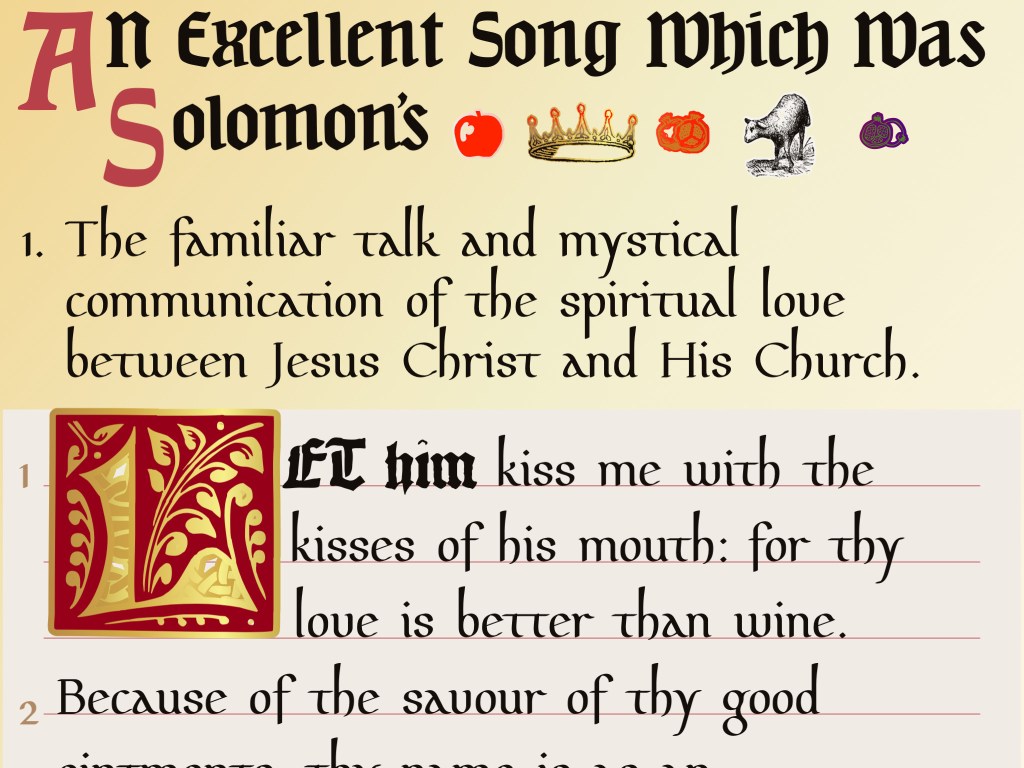
This is basically what you’d see if you opened to the title page of the Song of Solomon in the Geneva Bible, from the 16th century. But if you have an older physical copy of the King James Bible, you’ll probably see headings like this in it, too.
Now you can see the title: An Excellent Song, Which was Solomon’s. So, basically, Solomon wrote this really great song, it was the best thing he ever wrote.
But notice how it summarizes ch 1: The familiar talk and mystical communication of the spiritual love between Jesus Christ and His Church.
So, these days you see that and go: Huh? How did we get to Jesus?
Good question. Glad you asked. For most of Christian history, our ancestors in the faith insisted that each text had multiple levels or layers of meaning. There was the literal level—that’s kind of the plain, surface-level reading. But then there was the spiritual application.
And they would say, essentially, if you never get past the literal level, it’s like if I made you a chicken pot pie, but all you ate was the crust. The Holy Spirit stuffed a lot more good, healthy, meaty stuff in there, but now you’re malnourished because all you ate was the crust off the top.
So here’s an example. You have the Exodus—Moses led the Israelites through the Red Sea, and then it crashed down on their enemies and drowned them. That was a real, literal, historical event. So you have to read it that way first.
But then, there’s also the spiritual meaning. And generally, it’s going to be fulfilled in Christ. Again—the Exodus. In 1 Corinthians 10:2, when Paul says that the Israelites were baptized … in the cloud and in the sea—he’s drawing out the spiritual application.So the Exodus also represents our baptism and new life in Christ. We have passed through the Red Sea of His blood. Our enemies—Satan, sin, and guilt—lay dead on the other side, washed away by Christ.
And we can do this with the Song of Solomon—that’s what I’m doing today, and it’s what any preacher or scholar did with it for 1900 years. On the one hand, yes—you can read it as a love song of King Solomon for his bride. One of his many brides. That’s the literal reading.
And you can certainly make literal applications, in terms of learning how to speak romantically to your wife or your husband. Even though, truthfully—most of the poetic images aren’t going to work in today’s lingo. Dudes, I dare you to go home and tell your wife her hair is like a flock of goats, Song of Solomon 4:1!
But throughout Christian history, most of the preaching and teaching from this book was at the spiritual level. This is communicating the deep, transcendent spiritual love between Christ and His Church.
And it’s really not a stretch to get there.
After all, Revelation 21 portrays a marriage between heaven and earth, with the Church prepared as a bride adorned for her husband (v2). But I mean—even more to the point than that, what does Paul say in Ephesians 5? Husbands, love your wives, as Christ loved the church and gave himself up for her, that he might sanctify her. By the way, husbands—you don’t sanctify your wives, Christ does. And then it does on to say: He who loves his wife loves himself. For no one ever hated his own flesh, but nourishes and cherishes it, just as Christ does the church, because we are members of his body. “Therefore a man shall leave his father and mother and hold fast to his wife, and the two shall become one flesh.” This mystery is profound, and I am saying that it refers to Christ and the church.
So the Church is the Bride of Christ. Dudes, listen up—you’re still biologically men, but in spiritual terms, you’re part of the Bride of Christ. And there’s this one-flesh relationship between Christ and His Church. It’s intimate, it’s nurturing, it’s life-giving.
So it’s just completely natural, when you understand it all this way, that Christians opened the Song of Solomon, and read it in light of the teaching that we are the Bride of Christ—His love for us is that profound. This Song was Solomon’s first, but now, as Christ said: behold, something greater than Solomon is here (Matthew 12:42).
So the 17th century Puritan Richard Sibbes said, when he was preaching through Song of Solomon: As Christ and His Church are the greatest persons that partake of human nature—hey, did you hear how he just flattered you, Church?—since Christ and His Church are the greatest persons that partake of human nature, so whatsoever is excellent in the whole world is borrowed to set out the excellencies of these two great lovers.
So that’s what we’re going to do today. We’re going to zero in on a few passages from the Song of Solomon and just feast on them, and delight ourselves on what they have to teach us about the love and the joy that are shared between Christ and the Church.
First, we’ll talk about the union between Christ and His Church.
Second, we’ll see how Christ makes the Church fruitful. And I’ll have a few things to say about the Lord’s Supper in there, too.
And then, third, we’re going to talk about the mission of the Church, as the Bride of Christ in the world.
The mystical union between Christ and His Bride, the Church
So first, let’s talk about the union between Christ and His Church. And that’s going to be found in chs 2:16 and 6:3.
There’s a parallel between these two verses, see? My beloved is mine, and I am his … I am my beloved’s and my beloved is mine. You belong to Christ. And He belongs to you.
Do we think of ourselves as Christ’s beloved? Listen, Church—we are not Christ’s mail-order bride, okay? The marriage between Christ and His Church wasn’t a quickie Vegas marriage that He regrets now, like an ugly tattoo. There was no shotgun wedding where the Father made Him marry us. No, Christ says: I have loved you with an everlasting love (Jeremiah 31:3). We were chosen in him before the foundation of the world (Ephesians 1:4).
Christ gave His own body and shed His own blood on the cross to pay our dowry. A dowry is security, it’s surety—it’s your assurance that Christ is going to remain faithful, He’s going to preserve you and protect you and provide for all the needs of your soul.
So as soon as faith comes to life in you; and it grabs hold of Christ; and receives His promises in the waters of baptism; Christ adds you to His Church and He joins you to Himself. Now you can say: I am my beloved’s and my beloved is mine. What is mine is now His, and what is His is now mine. And listen—again, that began way back when the Word became flesh and dwelled among us (John 1:14). Right—He took on our flesh, our human nature, your human nature; so that He could be for you, and you could be for Him. He has become like us, so that He can make us become like Him.
So when you read these words, My beloved is mine, and I am his—you know what? Let’s say that together, and let those words sit and savor in your mouth and on your heartL My beloved is mine, and I am His. What belonged to you now belongs to Him, and whatever is His, is now yours.
He has taken your sin and misery upon Himself in His cross; and He has given you His righteousness, His holiness, and His resurrection. He was crowned with the thorns of your shame, yet He shall crown you with His own glory.
How deep does this great exchange go? 2 Corinthians 5:21 says that: For our sake—for the sake of the Church, for the Bride—[God] made [Christ] to be sin who knew no sin, so that in him we might become the righteousness of God. That’s how deep it goes. He became sin on the Cross, God crushed Him like sin itself; so that you and I, His Bride, could not only be called righteous; but so that we could be made God’s own righteousness.
Notice, too, that both these verses say, He grazes among the lilies. You know what this should make you think of, right? When Jesus said: Consider the lilies of the field, how they grow: they neither toil nor spin, yet I tell you, even Solomon in all his glory was not arrayed like one of these (Matthew 6:28-29). Beloved, you and I are the lilies of His field. We are clothed in Christ’s righteousness and holiness, and one day we shall be crowned with His glory—and we didn’t work for that. We didn’t sit at the spinning wheel, making our own wedding dress. Christ has arrayed us with garments of righteousness, that far surpass the glory of Solomon. So we read: he has clothed me with the garments of salvation; he has covered me with the robe of righteousness … as a bride adorns herself with her jewels (Isaiah 61:10).
When it says that Christ, the Lamb of God and our Bridegroom, grazes among the lilies, it means that He delights in us. It pleases Him to commune with us, to see us arrayed in the garments of salvation, and to consider the fullness of His joy and ours when we are gathered to Him in glory. Abide in my love, He tells us, that my joy may be in you, and that your joy may be full (John 15:10-11).
This is where our joy comes from, and our hope, and our perseverance: When we remind ourselves that we are Christ’s, and He is ours. We do not belong to ourselves; and yet—our Lord and Savior—belongs to us! Christ belongs to you, and the entire fullness of God’s nature dwells bodily in Christ, and you have been filled by him, who is the head over every ruler and authority (Colossians 2:9-10). You belong to Him, and He will never throw you away (John 6:37), neither will He allow anyone to steal you from His hand (John 10:28). After all, that hand bled for you.
Listen, this is where all the power to live and thrive and persevere as a Christian is found. Not in your good intentions. Not in your perfect repentance. But in knowing in our hearts that we belong to Him, and He belongs to us. That we are joined with Him as one flesh. And that, as we read in 1 Corinthians 1:30—though I am a fool, Christ is my wisdom. Though I am a sinner, Christ is my righteousness. Though my flesh is full of infirmity, Christ is my sanctification. And though I cannot save myself, He is my redemption.
I am my Beloved’s, and He is mine. He has taken me, and He has taken my sin and guilt away from me. And He has given me all that is His: His wisdom, His righteousness, His holiness, and His very life.
Christ makes His Bride fruitful
The second thing I want us to take from Song of Solomon today is found in ch7, v2. And that’s Christ makes His Church fruitful.
This is an interesting movement in the Song. As Christ is serenading His Bride, the Church, He sings: Your navel is a rounded bowl that never lacks mixed wine. Your belly is a heap of wheat, encircled with lilies. Ah, yes, men—say that to your wife on your wedding night.
Now, my first instinct whenever I see wheat and wine together in the Bible is to say—ah, we have a foreshadowing of the Lord’s Supper. And usually that’s a good instinct. And I do think you get there in this verse. But notice, Jesus isn’t saying that His Church’s belly is full of bread and wine. Rather, He says her belly is a goblet of wine, and a mound of wheat.
Now, in the Old Testament, grain and wine offerings were made along with the sacrifice of animals. You can read about that throughout Leviticus 23; and in Numbers 28:11-15. Of course, the bloody sacrifice of animals foreshadowed the blood of Christ which makes atonement for sin. But the offerings of grain and wine represented the work of the saints.
A couple of times we see Paul using this image for his own ministry—especially the sufferings and hardships associated with it. So in Philippians 2:17, and then again in 2 Timothy 4:6, he says: I am being poured out as a drink offering. So you see, the drink offerings and grain offerings represent the work of the saints, while the slaughtered lambs whose blood was poured out on the altar, represent the work of Christ.
This is how you need to understand Romans 12:1, by the way: by the mercies of God … present your bodies a living sacrifice, holy, acceptable unto God, which is your reasonable service. The point is, Christ has made atonement for us with His blood, upon the mercy seat. Now we offer our bodies—that includes our works, of course—as a living sacrifice. He has won our salvation by sacrificing His body. Now our works and our worship are the grain and wine offerings, poured out before God. He accepts our imperfect and feeble offerings as holy, because Christ has made us holy and acceptable to God. Therefore, our worship and good works are holy and acceptable, too.
I still can’t help but see the Lord’s Supper whenever Scripture brings grain and wine together. Here’s where I would see that here, and I feel compelled to point it out, because we don’t often make the connection between eating the Lord’s Supper; and being fruitful and productive for the cause of Christ. But if you skip your regular meals, how effective will you be at your work? It’s the same with the meal that the Lord has given us. Christ says: For my flesh is true food, and my blood is true drink. Whoever feeds on my flesh and drinks my blood abides in me, and I in him (John 6:55-56). And then of course, later He says: I am the vine; you are the branches. Whoever abides in me and I in him, he it is that bears much fruit, for apart from me you can do nothing (John 15:5). So you see, feasting on His body and blood, spiritually, through the bread and the wine is part of abiding in Christ. Just like having dinner with your spouse is a regular part of abiding with them. Right? Abiding just means your regular life together. And Christ says, the only way to be fruitful—to produce that good spiritual fruit in your life—is to abide in Him.
In the Lord’s Supper, we feast on Christ and are spiritually nurtured and sustained by Him. And then, the grace we receive from Him pours out of us as worship and good works, as He produces good fruit in us by the Spirit. As we abide in Him, and feast on Him, His Spirit dwelling in us grows and matures love in us, and joy, and peace, patience, kindness, goodness, faith, gentleness, and self-control.
So the thing about the fruit of the Spirit, and the thing about your good works—they’re not for God. He doesn’t need any of them. They’re for each other, and they’re for the world. Right—we need each other’s good works. Our neighbors need our good works.
And so there’s this picture here where Christ has made His Bride, the Church—us—He’s made it so, what does it say? Our bellies are this heap of grain, our navels are like a goblet of wine that never runs out. He makes His Bride fruitful for others. The grain and wine, those are our good deeds, but Christ is working them in us and through us.
And look, now we’re back to lilies again: Your belly is a heap of wheat, encircled with lilies. The lilies are picture of Christ crowning our good works with grace, adorning them with His delight, to make them beautiful. Like it says in John 1:16: from his fullness we have all received, grace upon grace. He makes us fruitful in worship and good works; and then He crowns His own good work in us with grace and beauty. That’s why food at the church potluck tastes better, y’all. Because Christ has crowned it with extra beauty.
So Christ makes His Bride fruitful, but the fruit is not just for us. It’s to be shared with the world. And that brings me to my final point.
Living as the Bride of Christ
Song of Solomon, ch 4:12, 16, teaches us about the Mission of the Church. What it means to live as the Bride of Christ in the world.
First, v12: A garden locked is my sister, my bride.
See how it says, my sister, my bride? That’s not a reference to something that happens in Alabama, okay? This is further evidence that we ought to read the Song of Solomon as a spiritual allegory of the love of Christ for His Church. It is teaching us that Christ’s love for His people is so perfect, He holds us with two affections: we are a sister to Him, and we are also His Bride. His love for us is so massive, that the Bible uses two kinds of human love together to express it.
He calls us His sister here because by taking on humanity, He has been made a brother to those who believe (Hebrews 2:11; 14; 17). And because Christ is our Brother, we are adopted by the Father in Him (Romans 8:14-17). And elsewhere, He says of His Church: whoever does the will of my Father in heaven is my … sister (Matthew 12:50).
But spiritually, as we have seen, we are His Bride, and He has paid our dowry with His own blood. So yes—His love for us is so perfect that He is bound to us by two kinds of affection. He calls His Church, my sister, my bride.
The Church, it says, is a garden enclosed. That is because we belong to Christ. The same way a wife is enclosed. Her garden is to be enjoyed by her bridegroom. So it is with Christ and His Church. We are for His special use and delight—that is, we are holy to Him.
This also reminds us of Eden, because the garden of Eden was an enclosed garden. Christ walks freely in His garden—His Church—by His Holy Spirit. And He says: I will walk among you and will be your God, and you shall be my people (Leviticus 26:12).
And as we’ve seen, by His Holy Spirit, Christ cultivates His garden and makes us fruitful. Again, He’s here among us growing that sweet fruit of love and joy, peace and patience, kindness, goodness, faith, gentleness, and self-control. He’s planting and nurturing and maturing all these in us.
We are enclosed not by force, but by the grace of God. We were set aside by Him through His foreknowledge, election, effectual calling, regeneration, and justification (Romans 8:29-30; Titus 3:5).
Finally, Christ says that His Church is to Him a spring locked, a fountain sealed. Again, this means He has set us apart for His own delight, and for His own special use in the world.
But this is also a promise of great comfort, because it assures us that Christ will keep us and care for us. After all, a man protects his own spring.
The Church is sealed by the Holy Spirit. Ephesians 1:13-14 says: when you heard the word of truth, the gospel of your salvation, and believed in him, [you] were sealed with the promised Holy Spirit, who is the guarantee of our inheritance.
We are also sealed by the promise of God, who foreknew us from eternity: But God’s firm foundation stands, bearing this seal: “The Lord knows those who are his” (2 Timothy 2:19).
The Church is called a spring and a fountain because Christ’s grace rests upon us, and He has promised that: whoever drinks of the water that I will give him will never be thirsty again. The water that I will give him will become in him a spring of water welling up to eternal life (John 4:14). The water Christ gives is the Holy Spirit (John 7:37-39), who continually waters and refreshes us, so that we never run dry, and are a fruitful garden.
Beloved, whatever is true of the Church is true of those who belong to her. Christ has bound you to Him with a double knot of love, for He is both a Brother and Bridegroom to you. You are His enclosed garden, and He delights in you. He abides in you. And He makes you fruitful by His Spirit.
O Church, know yourself as Christ’s sister, His Bride, His private garden and spring.
Then, in v16, Christ sings: Awake, O north wind, and come, O south wind! Blow upon my garden, let its spices flow.
Remember, we are His garden. And of course, we all know how beautiful a garden smells in spring, when it’s in bloom, and the winds are blowing on it.
The north and south wind Christ commands to blow through His Church is the Holy Spirit, to send out the fragrance into the world, and draw others to Christ. As Jesus says elsewhere: The wind blows where it wishes, and you hear its sound, but you do not know where it comes from or where it goes. So it is with everyone who is born of the Spirit (John 3:8).
The spices of the garden are the virtues and good works of the church, which proclaim Christ to their neighbors. The aroma of our good works invites our neighbors to taste and see that the Lord is good! (Psalm 34:8) And our godly manner of life arises from the Holy Spirit stirring in and through the Church. Through us, Paul says in 2 Corinthians 2:14, God spreads the fragrance of the knowledge of [Christ] everywhere.
Meanwhile, at the end of the verse, the Church invites Christ to abide in her, as she abides in Him: Let my beloved come to his garden, and eat its choicest fruits. Christ Himself samples our fruits—that is, He delights in our worship, our prayers, and our good works. They are His good work in us. Just as the farmer and the gardener and the winegrower delight in the food and drink and flowers their work has brought forth; so Christ delights in the good fruit He has brought forth in us, by His life, death, and resurrection for us; and through His Holy Spirit, in us and among us.
He is pleased to taste and see that His Bride has been made first pure, then peaceable, gentle, open to reason, full of mercy and good fruits, impartial and sincere (James 3:17).
Conclusion: The Spirit and the Bride say, Come!
Church, beloved Bride of Christ at Brooks Avenue—would we say, right now, to Jesus: Come into Your garden Lord, and eat its choicest fruits?
What about you—personally? Do holy spices—fragrant aromas of good work and worship and prayer—flow from your life, so that others catch a whiff of Christ in you? When He comes to His garden, does He find you pure, peaceful, gentle, reasonable, full of mercy and good fruits?
Friend, are you even joined to His Bride, the Church? Are you in that enclosed garden, where Christ dwells and grazes among the lilies? If not, you can come and talk to me, or one of the elders, or any number of other people here who have found rest and purpose and comfort as part of the Bride of Christ. We can help you be joined to Him in baptism, so that you can proclaim: I am my Beloved’s, and He is mine! Today is the day of salvation, friend: The Spirit and the Bride say, “Come.” And let the one who hears say, “Come.” And let the one who is thirsty come; let the one who desires take the water of life without price (Revelation 22:17 ESV).
And for all of us in the Church—our peace, our rest, our joy, our motivation, and our strength—comes from the fact that we are the Bride of Christ. Make it a habit to remind yourself, I am my Beloved’s, and He is mine. Rejoice in it. Remember that He has taken from you your sin and shame, and clothed you in His righteousness, and crowned you with His grace.
Don’t let the fear that your faith or repentance or prayers or works are not perfect. They never will be, but in Him, they are holy and acceptable to God, and beautiful in Christ’s hands. Offer Him your shaky faith, your spotty repentance, your stammering prayers, and your imperfect works, and He will make them fragrant spices in His garden, for God’s glory, and the good of others.
[1] Your two breasts are like two fawns, twins of a gazelle (ESV).
 the sermonator