
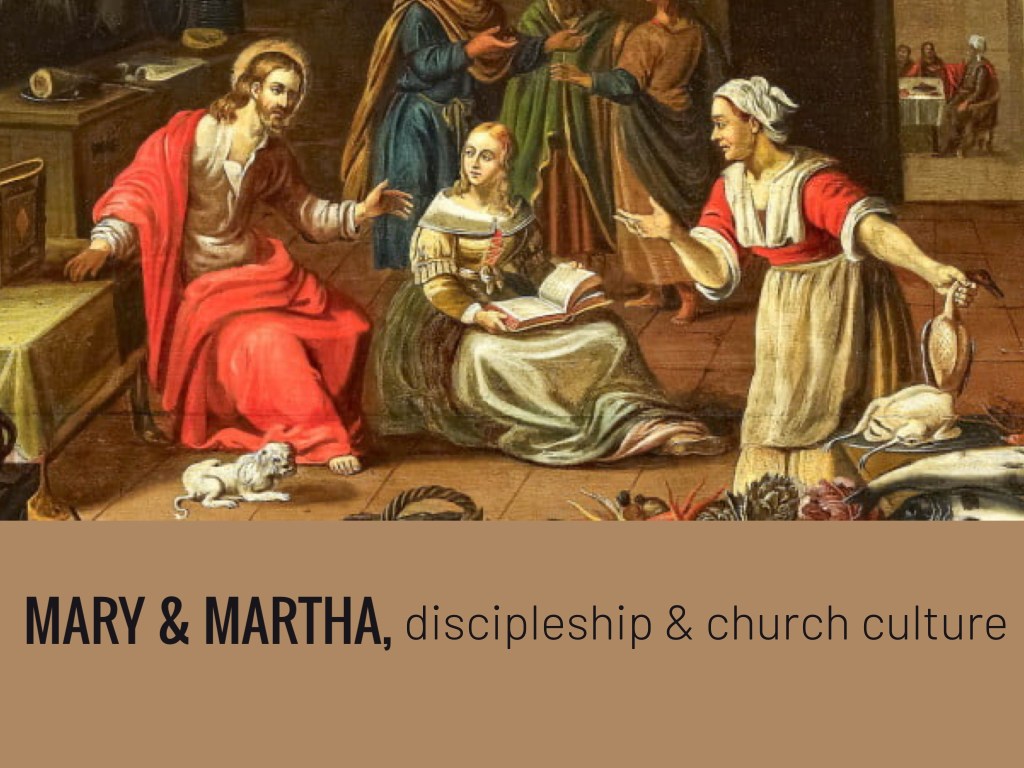
Luke’s little vignette about Mary and Martha is one of those stories we often hear in Sunday School growing up.
Now as they went on their way, Jesus entered a village. And a woman named Martha welcomed him into her house. And she had a sister called Mary, who sat at the Lord’s feet and listened to his teaching. But Martha was distracted with much serving. And she went up to him and said, “Lord, do you not care that my sister has left me to serve alone? Tell her then to help me.” But the Lord answered her, “Martha, Martha, you are anxious and troubled about many things, but one thing is necessary. Mary has chosen the good portion, which will not be taken away from her.”
Luke 10:38-42 ESV
Now, this story has been used teach many lessons, but today, for my purposes, one thing is necessary.
Or perhaps two things so closely related, like chips and guacamole, that they might as well count as one thing. They are discipleship and church culture.
Mary is seated as a disciple at the feet of Christ, eagerly listening to the teaching of the Word of God become flesh. Martha, meanwhile, is distracted with much serving. She is so focused on the doing of the things that she’s drawn off from what will actually make her profitable for service: the Gospel and the Law, proclaimed by their very Author.
Here’s what I want to suggest: Martha and Mary are two visions for the Church. They each embody a different understanding of discipleship, and the sort of church culture that produces disciples.
Martha is a Deeds over Creeds disciple. Discipleship is about what we do. “Okay everybody: Love God and love your neighbor, it’s that simple! Now let’s get busy! Mary, why the heck are you sitting there pondering the Trinity? We’ve got souls to save and mouths to feed! Stop wasting time! I’d rather see a sermon than hear one! Now, get up and go do what Jesus would do!”
Mary, meanwhile, may be taken for a Bible or theology nerd. And she may very well be. But Mary is by no means not a person of action. This is the same Mary who, a few days before Jesus died, took a pound of expensive ointment made from pure nard, and anointed the feet of Jesus and wiped his feet with her hair. John, who records the story, makes sure we know that: The house was filled with the fragrance of the perfume (John 12:3 ESV).
Mary served Christ extravagantly, too; and gave herself—body and soul and … hair—when she did. And when Mary poured out her service at her Master’s feet, the glory of it filled the house, and its sweetness lingered.
The Martha vision of church culture is a busy church, and discipleship is the business (busyness) of the Church.
The Martha church may indeed be doing many things, and yet … there’s an anxious and troubled energy to what they’re doing. They’re always saying, We need to work on this; and, I need to be better about that; and of course, They need to pay more attention to this over here, and get busy.
Next thing you know, you’ve got a whole congregation that’s stupid busy, but has completely lost the plot of the Gospel. They will nod impatiently and say, Oh, of course, of course!, when you ask: But wait, what about by grace through faith, not by works?
You know what that gets you? First, it gets you a bunch of disciples who are never secure in their salvation, because the Gospel is attenuated, if not anemic or even distorted. It gives you churches whose saints are anxious and troubled about many things. But they’re too afraid to say it out loud. The leadership is distracted with much serving, but has really forgotten who they’re serving and why. And these churches take on the anxieties and distractions of their leaders.
Second, notice I said it makes them stupid busy. Those church cultures become downright insipid. They’re an inch deep and a mile wide, but they’ve been discipled into mistaking width for depth. They haven’t grown in their knowledge of God since that sixth grade Bible Bowl tournament.
Of these, St. Paul would say: For I bear them witness that they have a zeal for God, but not according to knowledge. For, being ignorant of the righteousness of God, and seeking to establish their own, they did not submit to God’s righteousness (Romans 10:2-3 ESV).
Zeal for God not according to knowledge, will always lead to a functional rejection of the Gospel, resulting in increasingly frenzied attempts to establish our own righteousness. That is, to justify ourselves before God by our doings, our zeal, our fervor, our affections.
Let it not be lost on us, believer, the stink of self-righteousness that clings to Martha’s complaint against her sister. She doesn’t address Mary. Rather, she complains directly to the Lord about Mary, where Mary can hear her: Lord, do you not care that my sister has left me to serve alone? Tell her then to help me.
Why should this sluggard soak up Your grace, while I slave away in Your service? It’s unfair, Lord! One almost discerns Cain’s evil eye upon Abel, bitterness taking root in his heart as he sees his brother tending sheep, seemingly carefree; while he must fight with the thorns and the weeds.
Contrast this with the Mary vision for church culture and discipleship. See how eagerly and contentedly she sat at the Lord’s feet and listened to his teaching. She desires above all to know her Lord, and feast upon His Word, as it is written: Oh, taste and see that the Lord is good! Blessed is the man [or woman, in this case] who takes refuge in him! (Psalm 34:8 ESV).
Mary, by her posture at Christ’s feet, is saying: I will delight myself in thy statutes: I will not forget thy word. Deal bountifully with thy servant, that I may live, and keep thy word. Open thou mine eyes, that I may behold wondrous things out of thy law (Psalm 119:16-18 KJV). The Word of her God is her delight, her bounty, her sustenance, her vision, and her contemplation. She would know Him, and His ways: The works of the Lord are great, studied by all who have pleasure in them (Psalm 111:2 NKJV).
Mary loves Jesus for its own sake, for His own sake. She feels no need to be anxious and troubled about many things; or, distracted with much serving, when He would teach her.
Jesus, for His part, is for Mary, and the churches who would be like her, the fulfillment of Deuteronomy 33:3: Yes, He loves the people; all His saints are in Your hand; they sit down at Your feet; everyone receives Your words (Deuteronomy 33:3 NKJV, emphasis added). She sits at the feet of her Lord, receiving His Words, faith seeking understanding, secure in His hand, basking in His love.
And so a church with a Mary culture is a non-anxious church, and cultivates non-anxious disciples.
Mary has heard the Gospel and come to rest in Christ: Come to me, all who labor and are heavy laden, and I will give you rest. That invitation is for Marthas, too. Take my yoke upon you, and learn from me, for I am gentle and lowly in heart, and you will find rest for your souls. To come to Christ is to learn from Him, and to learn at His feet is rest. For my yoke is easy, and my burden is light (Matthew 11:28-30 ESV). So, if you are anxious and troubled about many things; and distracted with much serving, it is not Christian discipleship.
And so Jesus tells Martha, where Mary can hear Him: Martha, Martha … one thing is necessary. Notice that Jesus doesn’t “put her out of the Church,” as it were; for He says elsewhere that He calls his own sheep by name and leads them out (John 10:3 ESV). So here, He tenderly calls Martha by name, to lead her out of her anxieties and distractions, born, as they are from the frenzied struggle of trying to justify ourselves by our doings.
But He admonishes her: one thing is necessary. Not only one thing is necessary. Not that her administrative skills, her carefulness, her work ethic, or her culinary talents are out of place in His Church.
Rather, it is the Word of God that creates and sustains faith: So then faith cometh by hearing, and hearing by the word of God (Romans 10:17 KJV). Likewise, the preaching and teaching of the Word of the Lord is necessary for doctrine—that is, for theology—for reproof, for correction, for instruction in righteousness—that is, for ethics (2 Timothy 3:16 KJV). What makes the Church who she is the Word of the Lord, His Gospel and His Law, and His eternal decree. What makes the Church who she is, is that she is gathered at the feet of the Lord, attending to His teaching, finding rest to her soul.
Now, the Church needs our Marthas. Someone has got to put out the chairs, balance the budget, and conduct the meal trains. Marthas make excellent deacons, treasurers, secretaries, administrators, policy-writers, custodians, food pantry organizers, and the like.
But Marthas are not meant to set the tone and culture for the Church. For that matter, neither is Mary. Jesus does that.
But Mary in this story is a faithful model of a church whose culture is cultivated by Christ. For He says: Mary has chosen the good portion, which will not be taken away from her. Mary has chosen for her portion Christ, His finished work on her behalf, and His words to guide her. Instead of anxiously darting around trying to feed Him something impressive; she has sat at His feet to feast on Him, and on His words. And this cannot be snatched from her, by men or by the Devil himself. So Mary can say: My flesh and my heart may fail, but God is the strength of my heart and my portion forever (Psalm 73:26 ESV).
The Mary vision for church culture produces disciples who, in the course of their ordinary lives, do as St. Paul instructed: by the mercies of God … present your bodies a living sacrifice, holy, acceptable to God, which is your reasonable service (Romans 12:1 NKJV). You will indeed find them pouring out precious perfume on the Lord’s feet, and wiping them with their hair, if you’re ever privileged enough to see them visiting the sick; mourning with those who mourn and rejoicing with those who rejoice; binding up the bruised reeds and encouraging the smoking wicks. You’re going to see it in how they interact with their children, their spouse, and the Walmart greeter.
They may not look busy like those discipled in a Martha church culture. But that’s because they’re dribbling perfume here, dabbing it there, wafting it over there, without much fanfare, without panting or groaning.
And this is because they are not conformed to this world—which is full of busywork, anxieties, distractions, programs, virtue signaling, and performative “authenticity”—but have been transformed by the renewing of [their] mind (Romans 12:2 NKJV). That renewal of their mind has come from long years of sitting at the feet of Christ, listening to His teaching (which is found in all of Scripture, since He inspired it all, and it all proclaims Him), and resting in His finished work.
The difference here, is ultimately the difference between being a discipleship-focused church, and a Christ-focused church.
The discipleship-focused church—the Martha culture—has equated discipleship with their own elbow grease, fortitude, commitment, affections, and faithfulness. Being discipleship-focused means, ultimately, that I am focused on my own doings. Things like the proclamation of the Word, study, meditation, contemplation—these are luxuries for the indolent and indecisive. Even to pause and confess: we worship one God in Trinity, and Trinity in Unity; neither confounding the persons, nor dividing the substance; is akin to wasting time arguing over how many angels can dance through the eye of a needle or something.
My point is, if my focus is on my discipleship, I can never escape letting my left hand know what my right hand is doing. I’m fixing my eyes on my performance, and—God help me!— your performance; instead of on Christ and His perfect work for us.
But in the Christ-focused church—the Mary church culture—we sit at His feet and gaze adoringly at Him. We hang on His every word (that is, again, all of Scripture). We believe in Him, and our faith seeks understanding. We are happy to only be a few inches wide—where He has carefully placed us—so long as we can be drawn deeper into Him, and He into us. We are ravished by His beauty—and it is the truth, goodness, and beauty of our Lord and His ways that renew us day by day.
And so we give ourselves to Him. And that’s the secret sauce of the whole thing.
If your focus is on your discipleship, you lose sight of Christ. You’re going to pendulum swing between breathless efforts compelled by a nasty case of the shoulds; and embittered self-righteousness when you start to project your shoulds onto other believers—like Martha did to Mary.
But if your eyes are fixed on Jesus, and the words of your Lord are hidden and treasured in your heart—you get to the doings of discipleship without much ado, without losing sight of Him. The scent of your good deeds fills the room, and it’s sweet, because it’s not the smell of your own sweat, but the aroma of Christ that’s rubbed off on you.
 the sermonator