
Manuscript of a sermon presented at Brooks Avenue Church of Christ in Raleigh, NC June 23, 2024.
I had the privilege of filling in for our preaching minister, Bryan Moss.
If you’d like to watch, a link is embedded below.
A Storm-Tossed Church
Mark 6:45-52 is our preaching text today.
We are currently sojourning in the Gospel According to Mark, and we’re calling our series: I’ve got the Good News! The Gospel is the Good News, because the Gospel alone is the power of God unto salvation for all who believe it.
Black or white, young or old, rich or poor, men and women—the Gospel is the Good News that Jesus has come, and by His life, death, and resurrection, He has given us a new creation where sins are forgiven, where death works backwards, and where everything sad is going to come untrue. Amen?
Today’s Scripture picks up directly from last week’s. Jesus has just feed five thousand men—plus women and children—with a can of sardines and a pack of crackers. And after everybody got good and full—they still had twelve baskets of leftovers. One for each of His twelve Apostles to carry off for breakfast the next morning.
So now let’s listen together to the Word of God—this living Word that convicts and converts, that creates faith in cold dead hearts, and comforts sad sinners and weary saints.
Please stand to hear the Word of the Lord, Mark 6:45-52.
Immediately Jesus made his disciples get into the boat and go ahead to the other side, to Bethsaida, while he himself dismissed the crowd. After he had sent them off, he went up the mountain to pray.
When it was evening, the boat was in the middle of the sea, and Jesus was alone on the land. He saw them straining at the oars, because the wind was against them. About the fourth watch of the night, he went to them, walking on the sea. He was ready to pass by them. When they saw him walking on the sea, they thought he was a ghost, and they cried out. They all saw him and were terrified. Immediately he spoke with them and said, “Take courage! It is I. Do not be afraid.” Then he climbed up into the boat with them, and the wind stopped. They were completely amazed, because they had not understood about the loaves. Instead, their hearts were hardened.
The Word of God for the people of God—that you may believe. Let’s pray.
O Lord, though You lead us over troubled seas, let us always remember that Jesus is praying for us through every storm. The old ship Zion—Your precious Church—has never sank and never will! O Lord, may we hear our Master’s word today, and believe it: Take courage! It is I. Do not be afraid. For even though we sail through troubled waters, He will never leave us nor forsake us. In His Name we pray, Amen.
You may be seated.
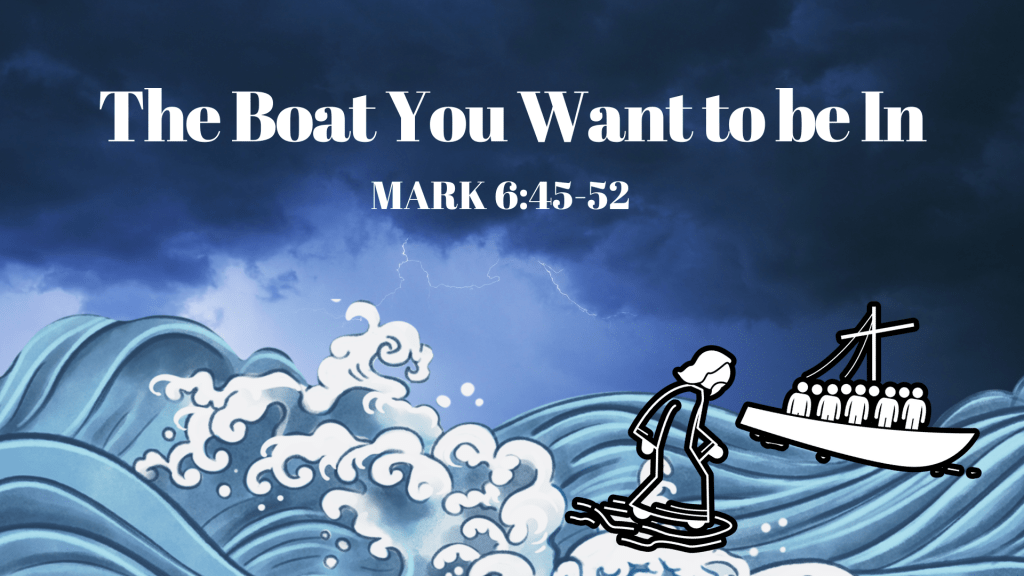
I’m calling today’s message The Boat You Want to Be In. You know, from the very earliest days of our faith, one of the primary images artists and preachers and songwriters have used for the Church is a boat or a ship, battered by the wind and the waves, but persevering.
And the story we just heard from Scripture is one of the reasons why this is such an enduring illustration. But this is also a recurring motif throughout the Bible.
You have Noah’s ark. You have baby Moses’ mama putting him in a little boat and sailing him down the Nile, to save him from being murdered.
You have the story we just heard a few weeks ago from Mark, where Jesus and His disciples are on a boat during a storm, and He stops the winds and the waves with a word.
This even shows up in church architecture, and hymns—this idea of the Church being like a ship.
The main part of the church building, where the congregation meets used to be called the nave. That’s from the old Latin word for boat, so you can see from that word why we call our fighting ships the navy.
And in the old spirituals of the Black American Church tradition, the Church is called the Old Ship of Zion. Slaves were brought to America on boats; but Jesus had built them a ship that would cross them safely to their ultimate freedom—the new heavens and new earth where righteousness dwells, 2 Peter 3:13.
But this all comes back to our story for today, you see. Because this is exactly what Mark wanted us to see—the Church is the boat you want to be in.
Beloved, look to your neighbors and tell them: This is the boat you want to be in.
You want to be aboard the Old Ship of Zion no matter how she is tossed about by the winds of uncertainty or the waves of persecution.
You want to be on this boat when your own sins and struggles and sorrows have you seasick.
And you surely want to be on this boat when the fiery storm of Judgment Day falls upon the earth—you want to be safely tucked away in Jesus, and among His people.
Because the only other option is overboard—to be battered by the storms of this life, all by yourself. Broken by sin. Buffeted by shame. Drowning in despair.
And finally, to find yourself in the lake of fire, with no lifeboat to heaven.
Well, beloved, that says most of it. Now here’s the rest of it.
Our story begins today with a storm-tossed Church.
V45, Mark says: Immediately—Mark loves that word, immediately.
His favorite words are, and and immediately. He doesn’t even use punctuation. Just says: and immediately—and moves from one story to the next.
Immediately—Mark says, immediately after they’d taken up those twelve baskets of leftovers, immediately after Jesus had fed five thousand men, plus women and children—Jesus made his disciples get into the boat and go ahead to the other side, to Bethsaida, while he himself dismissed the crowd.
Let me set the scene for you with a little bit of help from John’s Gospel. John 6:15 says that theses thousands of people Jesus had just fed—again, out of somebody’s lunch pail—it says Jesus realized that they intended to come and take him by force to make him king.
These people were in a frenzy, they were about to act up, they were about to start a riot.
So this is a very dangerous moment, for Jesus, for the crowds, and for His disciples. And Jesus knew that the Cross had to come before the Crown. That had been the plan from eternity.
So that’s why it says—look it says, Jesus made his disciples get into the boat and go ahead to the other side. Okay, you ever tried to get your kids into the car to leave; or to bed at night; when they were having too much fun?
That’s what was going on with Jesus and His disciples here. He had to say, Peter, James, John—all of You—get in that boat right now!
He made them get in the boat and leave before they got caught up in something they couldn’t control.
Jesus needed to calm the crowd—like we’ve already seen Him calm a stormy sea and a man full of demons—and send them home.
And He needed to get His disciples—His little Church—out of there. So He made them get into the boat and go ahead to the other side. He sent them away with their doggie bags of fish and hush puppies in their laps, and off they sailed into the sunset.
Now, look at v47. Once Jesus got the crowds under control, He looked out on the water—at that little boat, His little Church.
And it says: When it was evening, the boat was in the middle of the sea, and Jesus was alone on the land. He saw them straining at the oars, because the wind was against them.
Now again, I want to turn to some of the other Gospel writers to help fill out the scene, so we can see this from the disciples’ point of view. John says: A strong wind started to blow, and the sea became rough. Matthew says the boat was being pounded by the waves.
Okay, so for the second time in the Gospel story, this boat full of disciples—Christ’s little Church—is threatened by the wind and the waves. They’re in this little boat, being tossed around by a stormy sea.
And this time, Jesus isn’t where they can wake Him up and He can just make the wind and waves calm down.
And the disciples—listen—they’ve got the sail down, because the wind is against them; and Mark says they were straining at the oars.
And Jesus looked out across the water and saw themstruggling against the storm. John 6:19 tells us they rowed like this about three or four miles!
Now, here’s the first note for the margin of your Bibles. I don’t know how you’re going to take this. But here it is: Jesus sent His Church into trouble.
When the Prince of Preachers, Charles Spurgeon, preached on this passage, he said: Their sailing was not merely under His sanction, but by His express command. They were in the right place, and yet they met with this terrible storm.
Jesus made them get in that boat. And now they’re being tossed around on the winds and waves, and they’ve rowed against the wind for so long their strength is about to give out.
Does it seem to you like Jesus has sent them away from potential trouble with the crowd who wanted to make Him King; and into real trouble on the stormy sea?
Is Jesus a bungling Savior who flings His Church out of the frying pan, and into the fire? Heavens no!
I think some folks get this silly idea that Jesus would never send us somewhere dangerous.
And if we do end up someplace that’s dangerous or scary; or that’s draining our strength; or getting us into trouble—and we were trying to do what He told us to do—that surely Jesus wouldn’t put us in that position.
But there’s no such thing as unforeseen circumstances for Jesus.
But what was Jesus doing while the storm was tossing His disciples around, and they were rowing hard against the wind, with aching muscles and soggy beards?
V46 says that Jesus had gone up the mountain to pray. Now, that old rebellious Adam who still dwells in my flesh, and wants me to doubt—you know what he says?
He says: O, look at that Jesus! He’s just up there on the mountaintop, having His quiet time; while His Church is striving against the storm! They’re down there struggling, when He could end it all with a word. Why didn’t He pray for calm seas?
I wonder how His disciples felt on that boat as it was rocked by the storm all night, and Jesus was not with them?
I’m sure they remembered Him stopping the wind and waves before. Do you think they said, If only Jesus hadn’t insisted on us going on without Him, we wouldn’t be in this mess!?
Beloved—if you’re reading this story, you can’t run away from it. Jesus sent His Church into trouble. Into danger. Head on into a storm.
And He saw them struggling. And kept right on praying.
We’re in the Same Boat
Okay, here’s the second note for the margin of your Bibles: We’re in the same boat that they were.
And for the rest of our time today, that’s where we’re gonna stay. You and I are on that boat with those disciples, clutching our little picnic baskets of leftover fish and hush puppies.
We’re aboard that old Ship of Zion. We’re in the boat with those disciples—like I said, that’s the second note for the margin of your Bibles.
(I got three more. That’s right—you get five today! Let’s call it bonus content.)
See, what Mark wants to show us—Mark’s more of a shower than a teller, understand—Mark wants to show us that the Church of Christ is like this little boat the disciples were in.
This is how we need to see ourselves—both individually, and collectively. We are on a voyage through this life, through this fallen world. And listen, we are going to meet resistance, you understand. We are going to meet resistance.
Jesus cannot help but send us out into the world knowing we are going to meet with trouble. Rough seas, wild winds. There’s gonna be seasons where we’re soaked to the skin, we’re seasick from being tossed up and down—and our strength is not sufficient for the storm.
How many of you in this room today have had to sail through storms like those disciples had to sail through that night?
How many of you have had the wind against you, and you are rowing hard, and you don’t feel like you’re making any headway?
Mark is showing us, by this story, that the winds of culture will often blow against the Church, and the waves of circumstances will often crash against the people of God.
And when that happens—listen—it doesn’t take Jesus by surprise. He knew He was sending you into danger when He put you on the boat!
What does He say to us? Look, I am sending you out as sheep among wolves (Matthew 10:16).
He says: In this world you are going to have trouble (John 16:33).
So we have a choice. We can either become bitter and cynical and jaded and say: Lord, this isn’t what I signed up for! And abandon ship. But who’s about to jump out of the boat into a stormy sea? Who’s gonna take a dive off of Noah’s ark and try to go swimming?
So we can go overboard … or we can say: Though He slay me, yet will I trust Him (Job 13:15). And we can see how many saints the old Ship Zion has already delivered safely through the storms, and brought them to the Promised Land.
When Jesus sends us into trouble—listen beloved—it’s going to turn out for His glory and our good. Because it’s not in the still waters that we experience His power and Providence.
It’s not in the tranquil seas that we come to understand our insufficiency and His utter sufficiency.
It’s in the storms, when the winds are against us, and we have rowed until all our human power is spent, and we can’t make any headway—that’s where we learn to trust Him more perfectly. That’s how we learn to rest in Him alone.
The storm is always inconvenient, and never what we asked for, and usually we feel quite lonely and afraid. But it is only when we’re tried by the storm that we learn to boast all the more in our weaknesses, so that the power of Christ may shelter us; and to say: For whenever I am weak, then am I strong (2 Corinthians 12:9, 10).
So real quick now—well, as quick as I can make it—here’s the other three notes for the margin of your Bible. These are three promises Christ makes to us as we weather whatever storms He sends us into—and Mark shows them to us in this story.
Jesus Prays for us through the Storm
First—write this down in your Bible, or make a note in your app—Jesus prays for us in the storm.
We saw this already. V46, after Jesus had sent the crowds back home, he went up the mountain to pray.
What do y’all think He was praying about? Do you think He was up there having an Instagram-worthy quiet time?
Or do you think maybe He knew what kind of storm His little Church was about to encounter—and He was asking His heavenly Father to protect them and strengthen them?
Now Jesus is God. Which means He is all-wise. That storm didn’t catch Jesus off-guard.
Jesus—in His perfect wisdom—ordained that whatever winds and waves His little Church would meet on the water that night, was meant for their good.
I know—for me—when I go through a storm in my life, sometimes I get put out with Jesus. Y’all ever felt like that? Be honest, now.
But listen—that’s because I’m not realizing that this storm might be saving me from a shipwreck later on. I can’t see that these choppy waters now might be how Jesus is saving me from the lake of fire later.
You see, God has declared the end from the beginning (Isaiah 46:10), which means Jesus has a perspective—an eternal perspective—that I do not and cannot have.
But—in the words of Snoop Dogg—back to the lecture at hand. Jesus is praying for us—for you and for me, and indeed, for His whole Church—as we go through the storms.
Romans 8:34—listen, I love this—says that the same Jesus who died for our sins, and rose again to secure eternal life for His Church … Jesus isn’t just chilling out in heaven. Romans 8:34 says He is at God’s right hand and is also interceding for us!
That means—listen—He’s on a higher mountain than He was that night while His disciples were sailing against the storm. He’s on top of the heavenly Mount Zion, at the right hand of the Father, interceding for us … praying for us! … as we go through every trial and tribulation.
What’s He praying, do you think? Well, one thing He’s most assuredly praying is the same prayer He prayed for Peter on the night He was betrayed: But I have prayed for you that your faith may not fail (Luke 22:32).
Jesus is in heaven right now—listen—at the right hand of the Father, praying that our faith will not fail. That no matter how hard the winds blow, that your faith in Him will not be blown away. That the storm may overwhelm your strength and even your hope—but your faith will hold until He brings you safe into the heavenly harbor.
And isn’t God the Father going to hear the prayers of His eternally-begotten Son, and honor them?
That’s why Hebrews 7:25 says Jesus is able to save completely those who come to God through him, since he always lives to intercede for them. No matter what storm you’re weathering, the prayers of Jesus are there to sustain you until He’s brought you safely to the other side.
Jesus is with us through the Storm
Now, here’s the next note for the margin of your Bible: Jesus is powerfully present with us in the storm.
First of all, notice this: His little Church was never out of His sight during their ordeal. V48 says He saw them straining at the oars, because the wind was against them.
Even as He communed with His Father on the mountain, His eyes were on His people.
Then, v49 says: About the fourth watch of the night—between 3 and 6 AM—he went to them.
Why did He let them struggle until then? Well, Jesus always comes in the fullness of time, as it says in Galatians 4:4. I don’t think we can safely say anymore than that.
But what we can say is, when He saw—in His perfect wisdom—that the time was just right, he went to them.
He walked into the pitch black darkness to rescue His people, known chosen and beloved from before the foundation of the world (Ephesians 1:4-5).
He came for His people—He knew them by name, and He knew what they were going through, and He went to them.
And He walked out to rescue them like no human feet had walked before or since: he went to them, walking on the sea.
Now listen—the Sea of Galilee is like eight miles wide! He didn’t just take a few steps, you understand. He walked for miles in the dark, through the wind and the waves, to come rescue His people.
He didn’t just speak up and still the storm like He’d done before. He walked through it.
You see, this is showing us something. How God the Son, the Second Person of the Trinity, came into the dark night of sin and misery on earth, and walked through the fury of judgment, death, and the grave for us. To come rescue us, when we were too weak to rescue ourselves.
Now listen—its says: he went to them, walking on the sea. But check this, this is weird: He was ready to pass by them.
What was that all about?! Why was He just gonna walk past them? Hadn’t He come to save them?! Was this some kind of joke?!
No. This is—again—another example of Mark being more of a shower than a teller. He doesn’t do like Matthew and say: Here’s Immanuel, God-with-us. He doesn’t do like John and say: Here’s Jesus, God in the flesh among us. Mark shows us that Jesus is God.
So this goes back to something Job said, when he was being battered by the worst storm of his life, and was begging God to answer him. This is from Job 9. He said: [God] alone stretches out the heavens. He treads on the crests of the sea. And isn’t that exactly what Jesus was doing? Treading across the waves? But then, Job sighs and says: Though he passes by me, I do not see him. He moves past me, but I do not detect him.
But that night as Jesus passed by His disciples—He made sure they saw Him, as he tread on the crests of the sea.
Even Moses had to hide in the cleft of the rock as the glory of God passed by him! But that night, the storm-tossed disciples saw Jesus come along beside them. Jesus, who is the radiance of God’s glory and the exact imprint of the divine nature (Hebrews 1:3).
But they weren’t expecting to see Jesus. They weren’t expecting to see God-with-us walking across the stormy sea to save them. So we read in v49: When they saw him walking on the sea, they thought he was a ghost, and they cried out. They all saw him and were terrified.
They thought he was some evil water-spirit, like Jenny Greenteeth or the Storm Hag, come to wreck their ship and pull them down to the bottom of the sea. How often, in the midst of one of life’s storms, do we fail to see Jesus for Who He is?
But then Mark says: Immediately—Mark’s favorite word again—he spoke with them and said, “Take courage! It is I. Do not be afraid.”
When He says: It is I—literally in the Greek, He says: I Am. The same Name God spoke to Moses at the burning bush. He’s saying: Fear not, little flock, for Immanuel has come to shepherd you safely to shore. Then, Mark says, v51, he climbed up into the boat with them, and the wind stopped.
He was with them through the whole ordeal, though. Not just when He got in the boat. His eyes were on them. He was praying for them. When He was walking to them across the water, He was with them in Spirit.
And He could’ve stopped those winds any time. But the wind stopped only when He got on the boat with them. Only when they could see and know that the Great I Am was with them. This is so they would know—and so we would know, all these centuries later—that Jesus is the stiller of every storm.
The One who made the seas walks on the crests of the waves, and the One who made the wind can calm it, too.
And this Jesus—who came to them walking on the waters, and stilled the storms of terror in their hearts, and calmed the winds and waves that had been beating on them—this Jesus is the same yesterday and today and forever (Hebrews 13:8). He is still God-with-us in every storm.
Jesus was powerfully present with His disciples all along, whether they perceived Him or not. And we will not always perceive His presence with us during our storms. But we do receive His promise: I will never leave you, and I will never forsake you (Hebrews 13:5).
Jesus is Patient with us in the Storm—and beyond!
And now, here’s one final note for the margin of your Bible: Jesus is patient with us before, during, and after the storm.
Make no mistake, beloved—Jesus is always praying for us, and always present with us, storm or no storm.
But sometimes we act like knuckleheads even when there is no storm.
Sometimes, even on calm sunny days, we grumble and complain and gossip, we get ourselves into trouble He didn’t have nothing to do with, we aren’t thankful enough—so we need to remember His patience with us, storm or no storm.
Look at how the story ends, v52: They were completely amazed, because they had not understood about the loaves. What loaves? Those fish sandwiches they had in their baskets. The ones left over from yesterday’s miracle, when He fed thousands of hungry people off five loaves of bread and two fish.
They had seen that. They had eaten their fill from it. They even had leftovers with them! But look at that very last sentence of the story. Even with all they’d experienced, their hearts were hardened.
They did not yet understand that the God who fed a multitude in the wilderness with bread from heaven—back in Moses’ day—had come in the flesh to give Himself as bread for the world.
He was not the salvation they had asked for, expected, or wanted. But He was the Savior they needed.
Their hearts were hardened in unbelief. That is, until the One who once parted the waters of the Red Sea to rescue His people, came walking across the waters of the Sea of Galilee to rescue them. Only then did their hearts begin to soften a little.
It is the same with us, you know. We’re really in the same boat as them. On the sunny afternoons when everyone loves us, and our bellies are full—we have all that we need, and leftovers, too … we are apt to harden our hearts against Jesus. Oh, He’s a wonderful addition to our lives on the good days … but we find it very difficult to rely on Him wholly as our whole life—as all of our wisdom and righteousness and holiness and redemption.
It’s often when He reveals Himself to us through the storms of life that our hearts soften towards Him. That’s when we know there’s nobody else who can save us … or will. When we have exhausted all of our strength, and the wind is still against us. Then our hearts soften into amazement, for God has come to still the storm and bring us safely to the other side.
Beloved, don’t leave this nave today with your heart still hardened to Jesus Christ. Today is the day of salvation! Repent—cry out to Him that you have come to the end of your strength. Confess Him as Lord and God. And He will come walking to you, across the waters of baptism, and receive you into His ark of redemption—the old Ship of Zion. And He will guide you through every storm—even through Death itself—safely to Paradise.
 the sermonator