

Lines 38-43 of the Athanasian Creed essentially takes over from the earlier Creeds—the Apostles Creed and the Nicene Creed—concerning the work of Christ for the salvation of sinners. This is fitting, as the Athanasian Creed has established in lines 29-37 the proper doctrine of His Person.
The pertinent portion of the previous Creeds this line takes over are shown below.
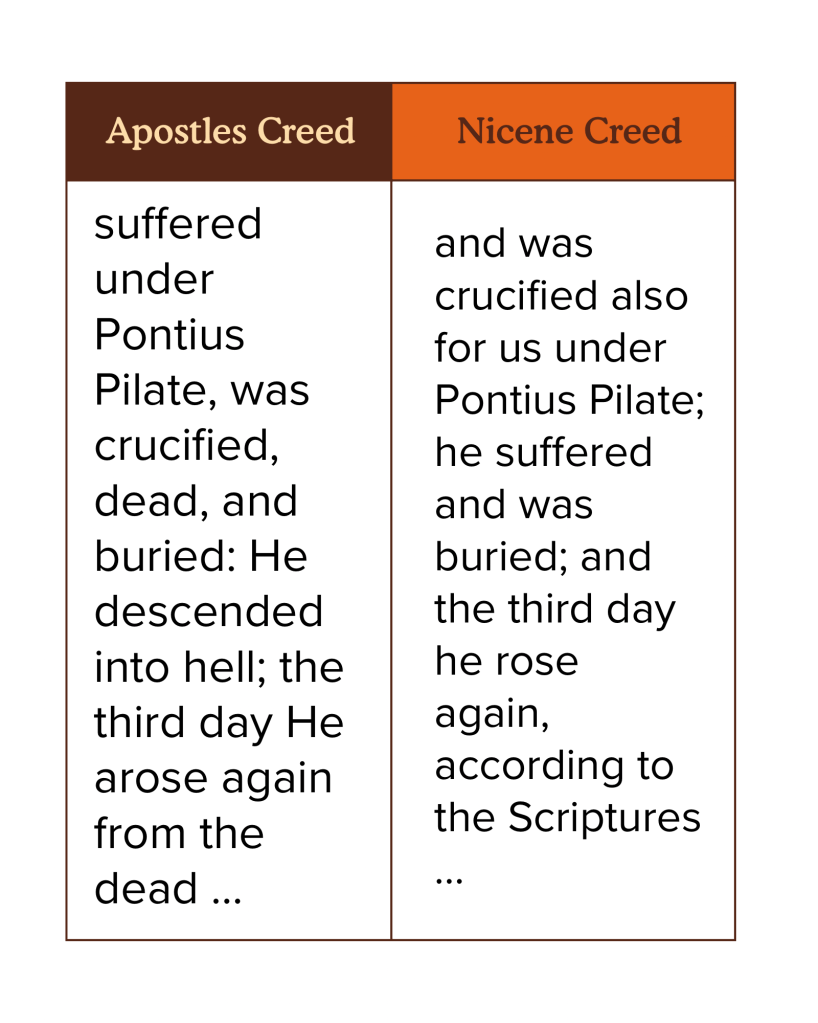
In this post we’ll look at our lesson from the Creed, and see the Scriptural proofs. In a follow-up post we’ll have an excursus on the perennially thorny clause, He descended into hell.
Lesson from the Creed
He suffered for our salvation;
He descended to hell; He arose from the dead.Athanasian Creed, Line 38
Explanation from Scripture
You could almost see this threefold list coming directly from Paul’s summary of the core facts of the Gospel: Christ died for our sins according to the Scriptures [He suffered for our salvation], and that He was buried [He descended into hell], and that He rose again the third day according to the Scriptures [He arose from the dead] (1 Corinthians 15:3-4 NKJV).
The Old Testament Scriptures (according to the Scriptures) did indeed foretell that Christ would die to atone for the sins of His people—or, as the Athanasian Creed has it: He suffered for our salvation.
This is most plain in Isaiah 52:13 – 53:12. Here’s a sample of verses from that passage:
He is despised and rejected by men, a Man of sorrows and acquainted with grief. And we hid, as it were, our faces from Him; He was despised, and we did not esteem Him. Surely He has borne our griefs and carried our sorrows; yet we esteemed Him stricken, smitten by God, and afflicted. But He was wounded for our transgressions, He was bruised for our iniquities; the chastisement for our peace was upon Him, and by His stripes we are healed. All we like sheep have gone astray; we have turned, every one, to his own way; and the Lord has laid on Him the iniquity of us all … He was cut off from the land of the living; for the transgressions of My people He was stricken. And they made His grave with the wicked—but with the rich at His death, because He had done no violence, nor was any deceit in His mouth. Yet it pleased the Lord to bruise Him; He has put Him to grief. When You make His soul an offering for sin, He shall see His seed, He shall prolong His days, and the pleasure of the Lord shall prosper in His hand. He shall see the labor of His soul, and be satisfied. By His knowledge My righteous Servant shall justify many, for He shall bear their iniquities.
Isaiah 53:3-6, 8-11 NKJV
Actually, look closely and you’ll see that not only His death as an atonement for sin is foretold in this prophecy; but also His burial (they made His grave with the wicked); and resurrection (He shall see the labor of His soul, and be satisfied).
But how did the Scriptures foretell His being raised from the dead on the third day, as St. Paul declared?
First, the story of Jonah in the Old Testament was a foreshadowing of Christ’s burial and resurrection. Jesus Himself proclaimed:
An evil and adulterous generation seeks after a sign, and no sign will be given to it except the sign of the prophet Jonah. For as Jonah was three days and three nights in the belly of the great fish, so will the Son of Man be three days and three nights in the heart of the earth.
Matthew 12:39-40 NKJV
Notice what Jesus said: as Jonah was three days and three nights in the belly of the great fish, so will the Son of Man be three days and three nights in the heart of the earth.
Jonah’s experience was a typological foreshadowing of Christ’s crucifixion, burial, and resurrection. Jonah was tossed into a stormy sea by pagan sailors, just as Jesus was nailed to a cross by a pagan governor (and by apostate Jews). Just as Christ went willingly to the cross to save sinners, Jonah volunteered to be tossed overboard to save his heathen shipmates: And he said to them, “Pick me up and throw me into the sea; then the sea will become calm for you” (Jonah 1:12 NKJV). Just as Jonah being tossed into the sea calmed the storm, so Christ’s death on the cross stills the fury of God’s wrath against sinners. And notice, that after three days and nights in the fish’s belly (Jonah 1:17), the Lord spoke to the fish, and it vomited Jonah onto dry land (Jonah 2:10 NKJV). Likewise, death and the grave could not “stomach” the righteous Jesus. As Peter declared at Pentecost: God raised [Jesus] up, having loosed the pains of death, because it was not possible that He should be held by it (Acts 2:24 NKJV).
So the story of Jonah is a prefiguration of the death, burial, and resurrection of Christ for our salvation. I love how St. Paul sums it up in Romans 4:25: He was handed over to death because of our trespasses and was raised to life because of our justification (EHV). The resurrection saves us, too. First, because it secures our future resurrection. But also because it’s God’s proof to us that He has accepted the death of Christ as an atoning sacrifice for those who believe in Him.
But the Old Testament also has another passage I can think of which seems to foretell the resurrection of Jesus on the third day. Hosea 6:2 says: After two days He will revive us; on the third day He will raise us up, that we may live in His sight (NKJV). Someone might ask: But this says us and we; and Jesus is only one Person!
That’s a valid point with a fairly straightforward answer. Since Christ is covenantally joined to His Church, our resurrection is comprehended in His. In that sense, on the third day, when the Father raised the Son by the Holy Spirit (Romans 8:11), the whole Church was raised in Him and with Him.
Now, you may have noticed that, as I began explaining this line of the Creed from the Scriptures, I connected His burial in 1 Corinthians 15:4; with He descended to hell from the Creed. Does this mean I take the Creed to simply mean that Jesus went into death or the grave?
No. It does mean that. But it also means more than that. There are a couple of—admittedly difficult!—passages in Peter’s letters that compel us, I believe, to understand that Christ was fulfilling some work of redemption in His descent, just as He did in His cross and resurrection. Those passages are as follows.
For Christ also suffered once for sins, the just for the unjust, that He might bring us to God, being put to death in the flesh but made alive by the Spirit, by whom also He went and preached to the spirits in prison, who formerly were disobedient, when once the Divine longsuffering waited in the days of Noah, while the ark was being prepared, in which a few, that is, eight souls, were saved through water.
1 Peter 3:18-20 NKJV
And:
For if God did not spare the angels who sinned, but cast them down to hell and delivered them into chains of darkness, to be reserved for judgment; and did not spare the ancient world, but saved Noah, one of eight people, a preacher of righteousness, bringing in the flood on the world of the ungodly … then the Lord knows how to deliver the godly out of temptations and to reserve the unjust under punishment for the day of judgment, and especially those who walk according to the flesh in the lust of uncleanness and despise authority.
2 Peter 2:4-5, 9-10 NKJV
One of these passages helps clarify the other, and there’s more to be said about Christ’s descent into hell when He preached to the spirits in prison, who formerly were disobedient.
But that’s for my next post in this series. I will simply leave it at this: I do not believe that Jesus went into hell to offer a second chance to those who perished in the Flood, or any other unbelievers. And neither the Apostles Creed nor the Athanasian Creed obliges anyone to believe that when it confesses: He descended into hell. But I do believe He did something during those three days that pertains to the redemption of His people. I’ll deal with that at length in my next post in this series.
 the sermonator
One response to “The Athanasian Creed from Scripture, Line 38”
[…] we saw in our previous post in this series, lines 38-40 of the Athanasian Creed essentially recapitulate the articles about the work of Christ […]
LikeLike