
Introducing the problem
As we saw in our previous post in this series, lines 38-40 of the Athanasian Creed essentially recapitulate the articles about the work of Christ in the earlier Apostles’ Creed.
A particularly thorny line for many Christians is the assertion that Christ descended to hell.
Indeed, many who object to Creeds point to that line as a prime reason for doing so.
Others, who understand the role the ancient Creeds play in articulating the Christian faith in its purity, will still either edit the line to: He descended into death; or reinterpret it as a reference to Christ suffering the torment of sinners on the cross; or move to excise it altogether.
Yet, these three proposals all have serious problems.
First, to amend the line to, He descended into death is redundant. If He died and was buried, we already know He “descended into death.”
Second, if we reinterpret it as a reference to Christ suffering the pains of hell (Psalm 116:3 KJV) on the cross, in the place of sinners, we’re going to butt heads with the Apostles Creed from which it is drawn. Because in the Apostles Creed, it says Jesus suffered under Pontius Pilate, was crucified, dead, and buried: He descended into hell; the third day He arose again from the dead. Obviously, the Apostles Creed understands the descent into hell as something that happened after His death and burial—not before His death as He suffered on the cross. And there’s no good reason to imagine that the authors of the Athanasian Creed thought any differently.
Third, simply excising it because we don’t like it essentially neuters the normalizing function of the Creeds. If we can pick and choose the parts we wish to believe, there’s no good reason for them.
What it doesn’t mean
Objections to this line are typically founded on historical interpretations that (I believe) really do miss the mark. By explaining what I’m certain the Creeds do not mean by, He descended to hell, I believe I shall also go a long way towards putting these objections to rest.
First, I do not believe that this line should be taken to mean that Christ went into hell and endured torment there. Hebrews 7:27 says that Jesus offered Himself once for all on the cross. Likewise, Romans 8:3 says God dealt with sin by sending His own Son in the likeness of sinful flesh, on account of sin: He condemned sin in the flesh (NKJV). Notice that God condemned sin in the flesh—that is, in Christ’s body on the cross. Not also His soul after death. God set forth Christ as a propitiation through His blood (Romans 3:25 NKJV). No further suffering was needed. Finally, 1 Peter 3:18 affirms: Christ also suffered once for sins, the just for the unjust, that He might bring us to God, being put to death in the flesh but made alive by the Spirit (NKJV). Christ suffered once for sins when He was put to death in the flesh. It was finished upon that cross! (John 19:30)
Second, I don’t believe that He descended to hell means that Christ went into hell to give sinners a second chance to repent and be saved. Hebrews 9:27 couldn’t be clearer: it is appointed for men to die once, but after this the judgment (NKJV). There is no opportunity for repentance and faith after death.
So what does it mean? We’ll come to that soon, but first, we’ll need a brief understanding of how the biblical audience understood their universe; and how that influenced the use of the world hell here.
The heavens, under the earth, and hell
Have you ever noticed that the Bible speaks of the heavens, plural? As in, In the beginning God created the heavens and the earth (Genesis 1:1 NKJV)? Or, The heavens declare the glory of God (Psalm 19:1 NKJV)?
That’s because the people to whom the Bible was written understood a threefold division to the space above the land. The first heaven is aēr—the atmosphere, up to the blue sky. The second heaven is ouranós—what we might call “outer space,” the dwelling place of the sun, moon, and starts. Then there was the third heaven, beyond our universe, which is the Heavenly Temple where God and spiritual beings dwell. St. Paul mentions this in his second letter to the Corinthians: I know a man in Christ who fourteen years ago … was caught up to the third heaven … and heard inexpressible words, which it is not lawful for a man to utter (2 Corinthians 12:4 NKJV).
Collectively, Scripture refers to these three divisions of heaven as the heavens.
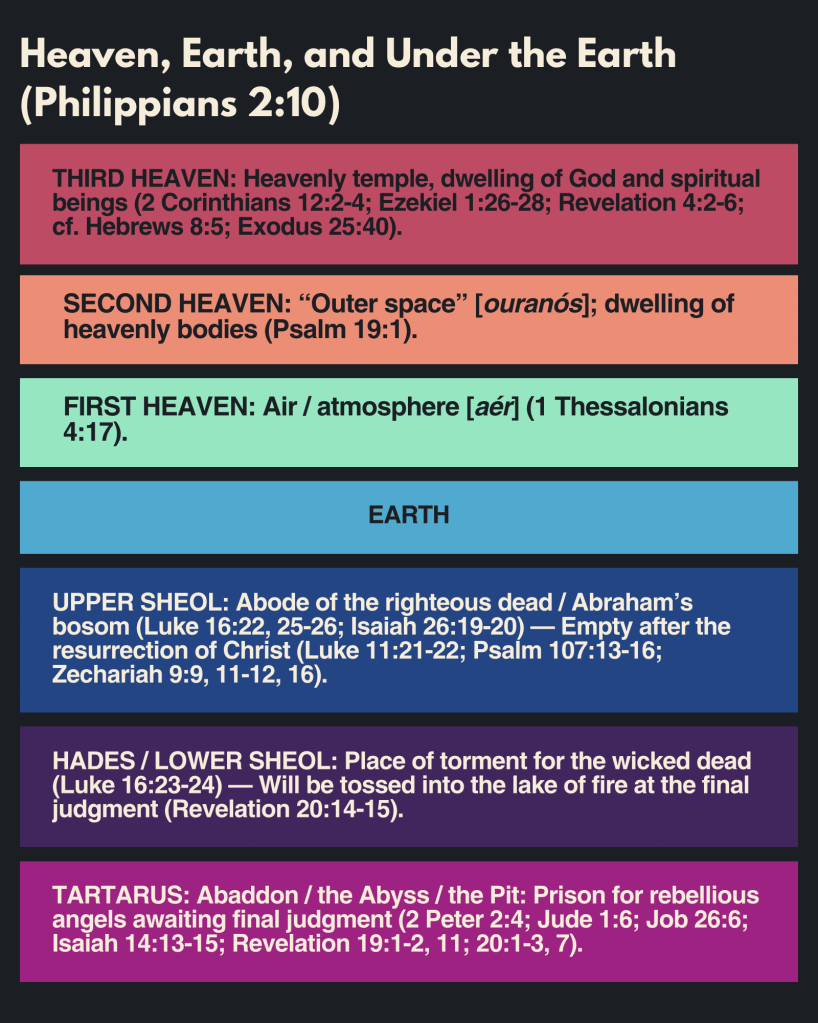
Scripture likewise seems to countenance a threefold division of the space under the earth (Philippians 2:10). Scripture speaks of Sheol (Hebrew) or Hades (Greek) as the abode of the dead. This is divided, as we see in the parable of the Rich Man and Lazarus (see Luke 16:22-26) into an upper Sheol, where the righteous dead rested; and a lower Sheol, where the wicked dead suffer torment. The dead were able to speak to one another across the upper and lower levels of Sheol, but between the two levels there is a great gulf fixed (Luke 16:26 NKJV), that keeps the wicked dead from defiling the rest of the righteous.
These, then—upper and lower Sheol / Hades—are the first two levels under the earth. They correspond to the first and second heavens.
Finally, there’s a third space under the earth, which Scripture refers to variously as Tartarus, Abaddon, Apollyon, the Abyss, or the bottomless pit. This is the prison where the rebellious angels are kept, awaiting final judgment.
Here’s a handy graphic that illustrates the three heavens and three levels under the earth, with Scripture proofs.
Now, if you’re reading, say, the King James Version; you’re going to find that it has hell where other versions have Sheol or Hades. For example:
If I ascend up into heaven, thou art there: If I make my bed in hell, behold, thou art there (Psalm 139:8 KJV).
If I ascend to heaven, you are there! If I make my bed in Sheol, you are there! (Psalm 139:8 ESV)
… and in hell he lift up his eyes, being in torments, and seeth Abraham afar off, and Lazarus in his bosom (Luke 16:23 KJV).
And being in torments in Hades, he lifted up his eyes and saw Abraham afar off, and Lazarus in his bosom (Luke 16:23 NKJV).
Here’s what’s going on. The English word hell is related to the old Norse concept of Hel—the underworld or realm of the dead. Hel is roughly analogous to the Hebrew idea of Sheol and the Greek Hades. Both the English hell and the Norse Hel are derived from the proto-Indo-European kel, meaning “hidden,” “concealed,” or “covered.” Our words “cell” and “cellar” are also derived from this common root.
So in older English hell simply meant the underworld, the hidden abode of the dead.
The confusion for English speakers comes in that translators also used hell to render Gehenna—the eternal torment to which Satan, his demons, and wicked humans will be consigned after final judgment: do not fear those who kill the body but cannot kill the soul. But rather fear Him who is able to destroy both soul and body in hell [gehenna] (Matthew 10:28 NKJV).
Gehenna hell is currently unoccupied. It will be the lake of fire, outside of the new heavens and earth, into which wicked humans will be cast along with the devil and his angels at the final judgement (Revelation 20:10-15): But the cowardly, unbelieving, abominable, murderers, sexually immoral, sorcerers, idolaters, and all liars shall have their part in the lake which burns with fire and brimstone, which is the second death … outside are dogs and sorcerers and sexually immoral and murderers and idolaters, and whoever loves and practices a lie (Revelation 21:8; 22:15 NKJV).
Newer translations have largely resolved the confusion around hell by simply transliterating Sheol and Hades, and reserving hell for Gehenna.
In light of this, He descended into hell need mean nothing more than Christ descended into the underworld—the abode of the dead. He would not go into hell—the lake of fire, Gehenna—because no one is there yet. It may be appropriate, then, to render this phrase: He descended to the dead; that is, into Sheol / Hades.
So, did Jesus actually do anything during His time in Sheol? Scripture answers that question affirmatively. He was not merely passively resting for the three days His body lay in the tomb. There are three things I believe we can say with Scriptural confidence, that Christ accomplished in His descent.
First, Christ entered into the realm of the dead—the place Philippians 2:10 calls under the earth. This includes Upper Sheol, Hades, and Tartarus / the Abyss.
Second, Christ proclaimed His victory to the dwellers under the earth. This was good news for those who died in faith (Hebrews 11:13), but news of terrible judgement for the rebellious angels and the souls of the wicked dead.
Third, Christ liberated the saints who had died previously, and led their souls to Paradise, to be with the Lord until the resurrection.
We will unpack these three claims from Scripture in future posts.
 the sermonator
3 responses to “The Athanasian Creed from Scripture: An excursus on Christ’s descent into hell, part 1”
[…] of the controversial line, He descended into hell, which begs further explanation. You can read the first post of this excursus here. In that, I mapped the ancient spiritual cosmography reflected in Scripture (three heavens; three […]
LikeLike
[…] Part 1 […]
LikeLike
[…] Part 1 […]
LikeLike