
We continue here our discussion of the difficult affirmation we find in the ancient Creeds that Christ descended into hell.
If you’re just now joining this study and need to get up to speed; or you need a refresher of what we’ve observed previously, you can link to the previous installments below:
In this post, we’ll trace Christ’s descent into the underworld from Scripture; and observe how this informs our understanding of the notoriously tricky passage 1 Peter 3:18-22; 4:5-6.
Christ descended into Upper Sheol
Corresponding to the First, Second, and Third Heavens, the underworld—which is called under the earth (Philippians 2:10); or the heart of the earth (Matthew 12:40); has three levels: Upper Sheol, Lower Sheol, and the Abyss.
Once again, here’s a handy graphic to help us visualize the biblical geography of what is in heaven, on earth, and under the earth.
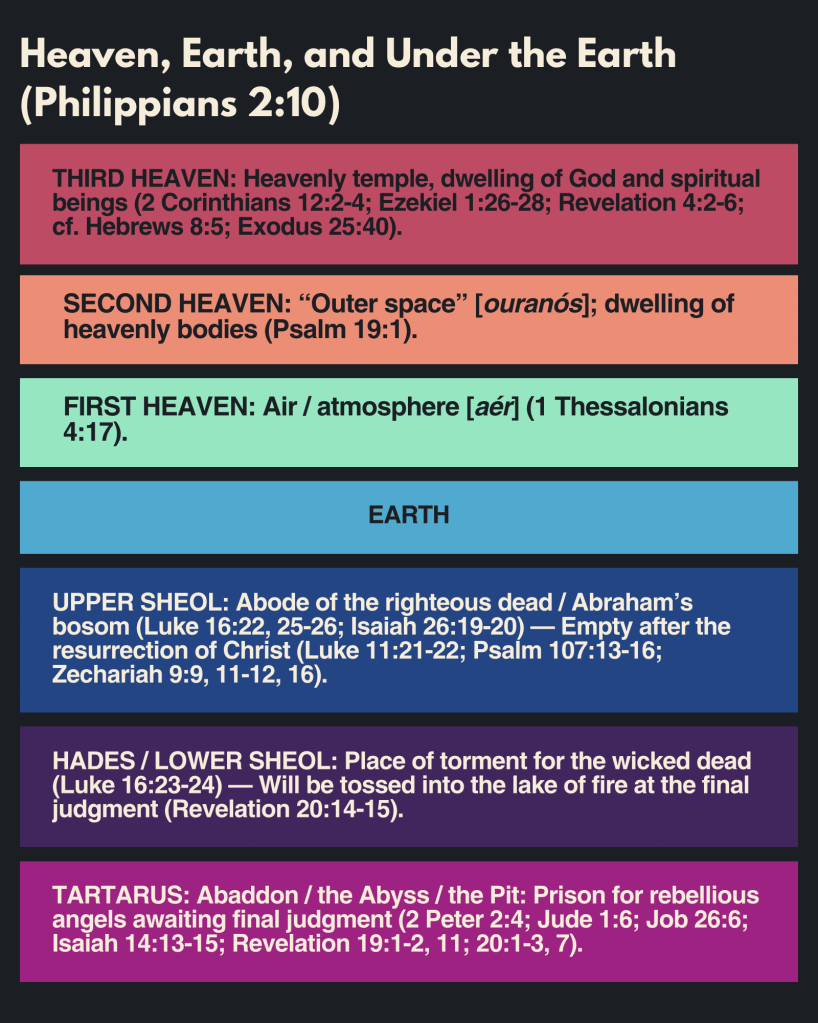
So first, we know Christ’s soul went into Upper Sheol. Why? Because there was only one ascension into heaven (John 20:17), yet when He was on the cross, He told the penitent thief who was crucified alongside Him: Assuredly, I say to you, today you will be with Me in Paradise (Luke 23:43 NKJV).
Now, since Christ did not ascend into heaven that day, He must have meant in the upper chamber of Sheol, which was also called Abraham’s bosom (Luke 16:22). This was the place where believers who had died went to rest and be comforted (Luke 16:25). Thus, both Christ’s soul, and the penitent criminal’s, descended into Upper Sheol upon death.
Paradise is an interesting word for this place. In the Bible, Paradise is more of a concept than a fixed location.
The Old Testament, looking back to the garden of Eden, refers to it as a paradise: You were in Eden, the garden [Hebrew gan = paradise] of God (Ezekiel 28:13 NKJV; cf. 31:8-9; Isaiah 51:3; Joel 2:3). A paradise is an enclosed garden, often belonging to a king, as in Ecclesiastes 2:5: I made myself gardens [Hebrew gannōth, paradises] and orchards, and I planted all kinds of fruit trees in them (NKJV; cf. Isaiah 1:30). Thus, Eden was called the garden—or Paradise—of God, because it was His private garden (notice how after the fall, God stationed cherubim at the eastern entrance to guard against trespassers, Genesis 3:24).
So, the concept of Paradise is that it is a private place, an enclosed or protected area. This is precisely what we see in the parable of the Rich Man and Lazarus (Luke 16:22ff). Abraham tells the Rich Man: between us and you there is a great gulf fixed, so that those who want to pass from here to you cannot, nor can those from there pass to us (Luke 16:26 NKJV).
The souls of the saints were protectively hemmed in, so that they could not be harmed by the wicked in death, as they had been in life. They could still see and speak to one another—they were in two chambers of Sheol—but they could only converse “over the gate,” as it were.
Zechariah 9:12a says: Return to the stronghold, you prisoners of hope (NKJV).
The dead in Upper Sheol were prisoners of hope. Having died in faith (Hebrews 11:13a), they waited in their underworld stronghold for their Redeemer—their true stronghold—to come and rescue them. They lived on in Upper Sheol as they had lived on earth: as strangers and pilgrims (Hebrews 11:13b).
So when He died, Christ went in the spirit (1 Peter 3:18 EHV) into Upper Sheol, also called Paradise, or Abraham’s bosom. There, He called His prisoners of hope to Himself and met them, saying: Even today I declare that I will restore double to you (Zechariah 9:12b NKJV). More on this double-restoration later.
Christ descended into Lower Sheol (Hades)
In Acts 2:26-27, Peter the Apostle quoted Psalm 16:9-10, and applied it to the burial and resurrection of Jesus: Moreover my flesh also will rest in hope. For You will not leave my soul in Hades, nor will You allow Your Holy One to see corruption (NKJV).
Hades is the Greek equivalent to Sheol, and this includes lower Sheol, where the wicked and unbelieving dead await final judgment: And being in torments in Hades, he lifted up his eyes and saw Abraham afar off, and Lazarus in his bosom (Luke 16:23 NKJV).
Yet, Christ did not descend into Hades to languish among the wicked, but to proclaim a message. This also was foretold in the Psalms:
I believed, therefore I spoke … “Precious in the sight of the Lord is the death of His saints. O Lord, truly I am Your servant; I am Your servant, the son of Your maidservant; You have loosed my bonds.”
Psalm 116:10, 15-16 NKJV
Christ descended into Hades to speak a message. He spoke as the virgin-born servant of God, whose death was precious in the eyes of the Lord. He spoke of liberation—of bonds being loosed.
Now, it’s very interesting that the same St. Peter who preached Christ’s descent into Hades in Acts 2; also wrote in 1 Peter 3:18b-19 that Christ was made alive in spirit, in which he also went and made an announcement to the spirits in prison (EHV). What was the content of the message He preached? We’ll consider that soon. But first, we have one more stop to make on Christ’s descent into the underworld.
Christ descended into the Abyss
Just as there is a third heaven—the highest heaven; there is a third chamber under the earth—the lowest vault of the underworld.
This lowest level is reserved for disobedient angels who joined Satan in his rebellion. It is variously referred to in Scripture as the Abyss (Luke 8:31), Tartarus (2 Peter 2:4; cf. Jude 6), Abaddon (Job 26:6); and the Pit (Isaiah 14:15; Revelation 20:1-3, cf. 7).
And according to Scripture, Christ did indeed descend even to the Abyss, for in Romans 10:6-7 Paul says: Do not say in your heart, … “Who will descend into the abyss?” (that is, to bring Christ up from the dead) (NKJV). Thus, the Scripture affirms that, after His death, Christ’s spirit descended to the deepest depths—indeed, into the abode of the Devil and his angels.
But again—as we saw above, He did not go down into the dark Abyss to suffer among the demons. Rather, He went to speak. He descended with a message.
Bearing on 1 Peter 3:18-22; 4:5-6
So, let’s return to 1 Peter 3:18-22; 4:5-6:
Christ also suffered once for sins in our place, the righteous for the unrighteous, to bring you to God. He was put to death in flesh but was made alive in spirit, in which he also went and made an announcement to the spirits in prison. These spirits disobeyed long ago, when God’s patience was waiting in the days of Noah while the ark was being built. In this ark a few, that is, eight souls, were saved by water. And corresponding to that, baptism now saves you—not the removal of dirt from the body but the guarantee of a good conscience before God through the resurrection of Jesus Christ. He went to heaven and is at the right hand of God, with angels, authorities, and powers made subject to him … They will have to give an account to the one who is ready to judge the living and the dead. In fact, it was for this reason that the gospel was preached also to those who are dead, so that they might be judged the way people are judged in flesh and that they might live the way God lives in spirit.
EHV
Are the spirits in prison to whom Christ went and made an announcement, in the spirit; the same as the dead to whom the gospel was preached? Are these two passages referring to the same event?
It doesn’t seem so. The climax of this section is a discussion of final judgment, when the wicked and unbelieving will have to give an account to the one who is ready to judge the living and the dead. This includes the wicked and unbelieving angels, authorities, and powers who have been made subject to Christ. In other words—the Devil and his demons.
But if there were a second chance for them to repent and believe, even in Sheol and the Abyss, this whole section would fall apart.
In context, when the section concludes that the gospel was preached also to those who are dead, this goes all the way back to the days of Noah. It’s referring to the Gospel being preached to them while they were living—not after death.
In other words, these people had died before Peter wrote his letter; but the Gospel had been preached to them before they died.
But who preached the Gospel to them? Well, Noah, for one. In 2 Peter 2:5, Peter calls Noah a preacher of righteousness. He proclaimed a coming judgment, and also a means of escaping judgment, aboard the Ark he was building. Noah then preached the Gospel to a whole generation of wicked unbelievers, who did not repent, and are now awaiting their final judgment.
The spirits in prison to whom Christ made an announcement during His descent into the underworld include those who didn’t repent at Noah’s preaching and the rebellious angels, authorities, and powers (cf. 2 Peter 2:4; Jude 6).
And His message to the devils and the unbelieving dead was not conciliatory.
We’ll consider Christ’s announcement to the underworld and what it accomplished in our next post—the final word in this excursus on Christ’s descent.
For now, I will simply say this: Christ’s descent into “hell” was the beginning of His exaltation, not the final level of His humiliation. While His body rested in the tomb, sanctifying the grave for those who believe in Him; in His spirit He was in the underworld, beginning to set things to rights.
 the sermonator
One response to “The Athanasian Creed from Scripture: an excursus on Christ’s descent into hell, part 3”
[…] Part 3 […]
LikeLike