
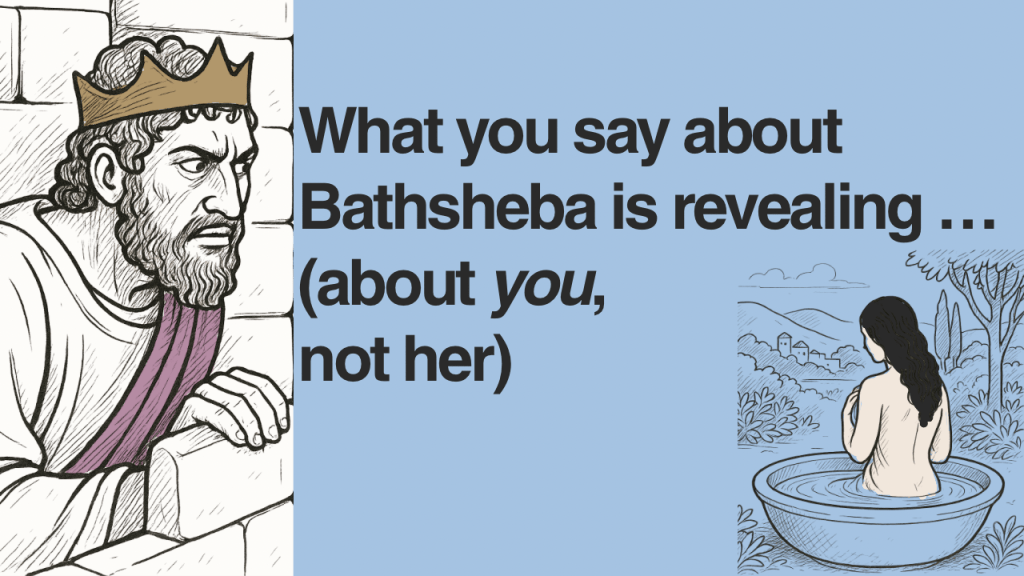
Whenever I crack open a new-to-me commentary on 2 Samuel, I make a beeline for how the commentator handles 2 Samuel 11, the sordid story of King David’s sin involving Bathsheba. I discovered long ago that their read of the story is often revealing. If I can’t trust you to handle this story with care — for example, by noting that God pins responsibility for the thing solely on David in ch12 — this raises questions for me about your interpretive integrity in general.
I’d also suggest that how a person understands the events of 2 Samuel 11 might also reveal something about their own mindset, when it comes to matters of men and women, sexual violence, and power dynamics.
Case in point: Take a look at how Bishop Robert Barron frames the story in his 2015 volume on 2 Samuel from the popular Brazos Theological Commentary on the Bible series.
Indeed, it would be naive in the extreme to construe Bathsheba as totally innocent— she just happens to be bathing nude within easy eyeshot of the king? … This interpretation is given added weight by the author’s dry observation that Bathsheba had been purifying herself — almost certainly the ritual bath after menstruation. According to the standard Jewish sensibility, a woman was particularly receptive to conception in the week or so just following menstruation. Therefore one might be justified in thinking that the rooftop bath was far from innocent but rather a none-too-subtle advertisement to the king that Bathsheba was interested in becoming pregnant. That Bathsheba is far from a merely passive object of manipulation is emphatically confirmed at the beginning of 1 Kings, where we learn that she cleverly and successfully lobbies the aged David to allow her son Solomon to succeed to the throne.
So there we have it. According to Bishop Barron, the whole thing was cooked up by sneaky Bathsheba, so she could bear a son by the king.
Just in terms of a visceral reaction — that’s a rather disgusting read of the story.
But more importantly, in fidelity to the text, nothing in 2 Samuel 11; nor in the prophet Nathan’s confrontation with David in ch12; nor in Psalm 51, which David wrote in repentance; suggests any of the sort of thing Bishop Barron describes. Once the king is called to account by the prophet, we read: David said to Nathan, “I have sinned against the Lord (2 Samuel 12:13 RSV).
Not, “Bathsheba and I have sinned.” No. “I have sinned.”
Barron’s commentary on 2 Samuel was published in 2015. Fast forward to 2021 – 22, when the Catholic media ministry Barron founded, Word on Fire, decided to fire their highest- paid employee as an investigation found credible evidence of sexual harassment and assault of multiple women in his private life. [1]
The fallout was massive, with several employees resigning, citing a company culture that was unfair, unsupportive, and unsafe for women.
One female employee resigned after an October 2021 staff meeting where Bishop Barron actually named one of the victims of the employee being investigated, without the victim’s consent. This is all the more disturbing because the meeting had been called to discuss matters like sexual misconduct and employee intimidation in the wake of the investigation and firing.
This woman who resigned spoke frankly regarding systemic cultural issues at Word on Fire — in particular, not feeling safe or supported by Bishop Barron and Word of Fire CEO Steve Grunow, also a Catholic Priest. “To put it bluntly,” she stated, “I do not feel that if I had been one of the victims, I would have been protected in any way. I also do not trust that if I were to be a victim in the future, Bishop Barron or Father Steve would view sexual assault in a way which would be sympathetic to a victim.” (emphasis added)
Notice her concern that Robert Barron would be unsympathetic to a victim of sexual assault. Consider that fear in light of Barron’s presentation of Bathsheba in 2 Samuel 11. Do you see a connection?
She continued:
From the beginning, it was clear that my safety was not prioritized. It was common knowledge that Joe [the man fired for unwanted and unwelcome sexual behaviors] was not trustworthy with women. He dated much younger women, and people openly discussed the extreme favoritism that he received from Bishop Barron and Fr. Steve. He got away with more, and he did what he wanted. Even his blog, which has since been removed, discussed marriage as a conquest …
The first time I spoke to Joe in person, he asked me if I was married within a few minutes of speaking.
Although it was well-known that Joe was not someone to trust with women, he was given no restrictions …
As a survivor of sexual abuse myself, it was horrifying to see Bishop discuss these serious matters in the way in which he did. This call did not appear to be rehearsed, which made it all the worse—these were his genuine thoughts regarding the matter. The women were simply accusers, and Joe’s reputation needed to be prioritized over them. He needed to be prioritized over their privacy, over their testimonies, and over the safety of our coworkers (which was made clear when we found that Fr. Steve had threatened other employees who asked about what had happened to Joe). [emphasis added]
Again, consider the lengths to which Barron went in his commentary to mitigate damage to David’s reputation by slandering Bathsheba. He even leaned into the “Bathsheba on the rooftop” trope: “one might be justified in thinking that the rooftop bath was far from innocent.” But Scripture is plain that it was David on his roof, spying on Bathsheba: “And it came to pass in an eveningtide, that David arose from off his bed, and walked upon the roof of the king’s house: and from the roof he saw a woman washing herself; and the woman was very beautiful to look upon” (2 Samuel 11:2 KJV)
Can a man who is willing to slander a long-dead woman who isn’t around to defend herself; and who’s very loose with the biblical text in doing so; be trusted with the safety of women when a man is behaving inappropriately towards them?
That’s really my bigger point in writing all this. I don’t think it’s suggesting too much to say you can draw a straight line between Bishop Barron’s inexcusable mishandling of Bathsheba’s story; and his inexcusable mishandling of the stories of women who have been victimized by one of his male employees; and his lack of concern regarding the safety of women who work in his organization.
Or, TL;DR version: What you say about Bathsheba reveals something about you.
At this point, I think we can all agree that when someone interprets 2 Samuel 11 in a way that casts aspersions on Bathsheba, that’s a massive red flag. Women are not safe in spaces these men inhabit, or cultures they form, shape, and lead.
[1] While this sounds appropriate and laudable, it seems protocol wasn’t followed in this case. The employee was first placed on administrative leave pending investigation. The timing of his actual firing seems more like a PR move. Once it became known within the organization that one of the women had shared her story in a private FB message group that included Word On Fire employees, they summarily fired the man instead of allowing the investigation to play out, disrupting protocol.
 the sermonator